
Reading a food label can feel confusing at first. Words like serving size, calories, total sugars, added sugars, dietary fiber, sodium, % Daily Value, and ingredients can make a simple shopping decision seem complicated.
The good news is that you do not need to understand every number on a package to make better food choices. Learning a few important parts of the label can help you compare products and choose foods that better fit your everyday nutrition needs.
In this guide, we’ll explain how to read a nutrition label step by step, what the most important numbers mean, and what to check before buying packaged foods.
Note: Nutrition labels can differ between countries. The examples in this article use the general structure of the U.S. Nutrition Facts label, while the basic principles can also help when reading packaged-food labels in other countries.
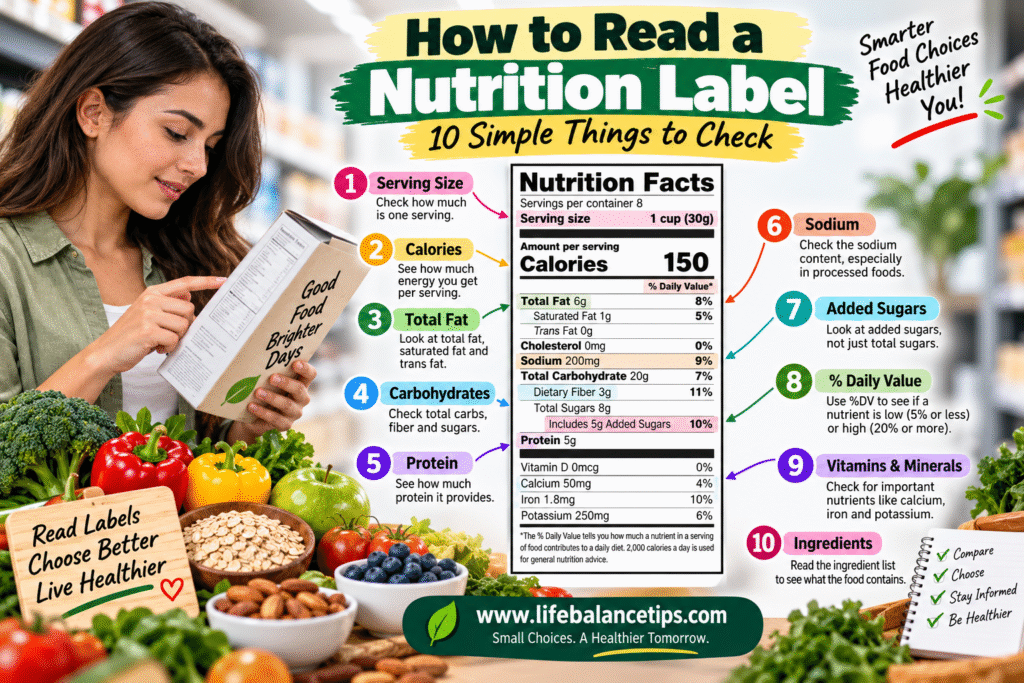
What Is a Nutrition Label?
A nutrition label provides information about the nutritional content of a packaged food or drink. Depending on the country and product, it may show information such as calories, fat, carbohydrates, sugars, protein, fiber, sodium, vitamins, minerals, serving size, and ingredients.
The FDA explains that the Nutrition Facts label is designed to help consumers make more informed food choices. (U.S. Food and Drug Administration)
But there is one important rule to remember:
Do not judge a food only by one number.
Instead, look at the serving size, calories, key nutrients, added sugars, sodium, and ingredient list together.
How to Read a Nutrition Label Step by Step
Here are 10 simple things to check.
1. Start With the Serving Size
The first thing to check is the serving size.
Nutrition information is generally based on the serving size shown on the package. The label may also tell you how many servings are in the entire container. (U.S. Food and Drug Administration)
For example, imagine a snack package says:
| Information | Per Serving |
| Serving size | 30 g |
| Calories | 150 |
| Protein | 5 g |
| Carbohydrates | 20 g |
| Fat | 6 g |
If you eat 60 g instead of 30 g, you have eaten two servings. That means you would consume approximately twice the calories and nutrients listed per serving.
What to ask yourself
Before looking at calories, ask:
- How much is one serving?
- How many servings are in the package?
- How much am I actually going to eat?
This is one of the most important steps when learning how to read a nutrition label correctly.
2. Check the Calories
Calories indicate the amount of energy provided by a serving of food.
The FDA notes that 2,000 calories per day is used as a general reference for nutrition advice, but individual calorie needs can be higher or lower depending on factors such as age, sex, body size, and physical activity. (U.S. Food and Drug Administration)
Calories can be useful when you’re trying to understand your overall food intake, but they should not be considered alone.
For example, two foods could have similar calories but very different amounts of:
- Protein
- Fiber
- Added sugar
- Sodium
- Vitamins and minerals
So don’t automatically assume that the food with fewer calories is always the better choice.
3. Look at Total Fat and Saturated Fat
Fat is an essential nutrient, but the type and amount matter.
Nutrition labels commonly separate total fat into categories such as:
- Total fat
- Saturated fat
- Trans fat
When comparing packaged foods, pay particular attention to saturated fat and avoid assuming that all fats are the same.
For everyday choices, consider the overall food rather than simply choosing the product with the lowest fat number.
For example, nuts and seeds naturally contain fat but can also provide protein, fiber, vitamins, minerals, and other nutrients.
4. Check the Carbohydrates and Fiber
If you’re wondering how to read a nutrition label for carbs, start with the Total Carbohydrate section.
It may include:
- Dietary fiber
- Total sugars
- Added sugars
Why fiber matters
Dietary fiber is an important part of a healthy diet. Foods containing fiber can include whole grains, beans, lentils, fruits, vegetables, nuts, and seeds.
When comparing similar packaged foods, a product with more dietary fiber may be a useful option, depending on your overall dietary needs.
The FDA identifies dietary fiber among the nutrients consumers may want to get more of. (U.S. Food and Drug Administration)
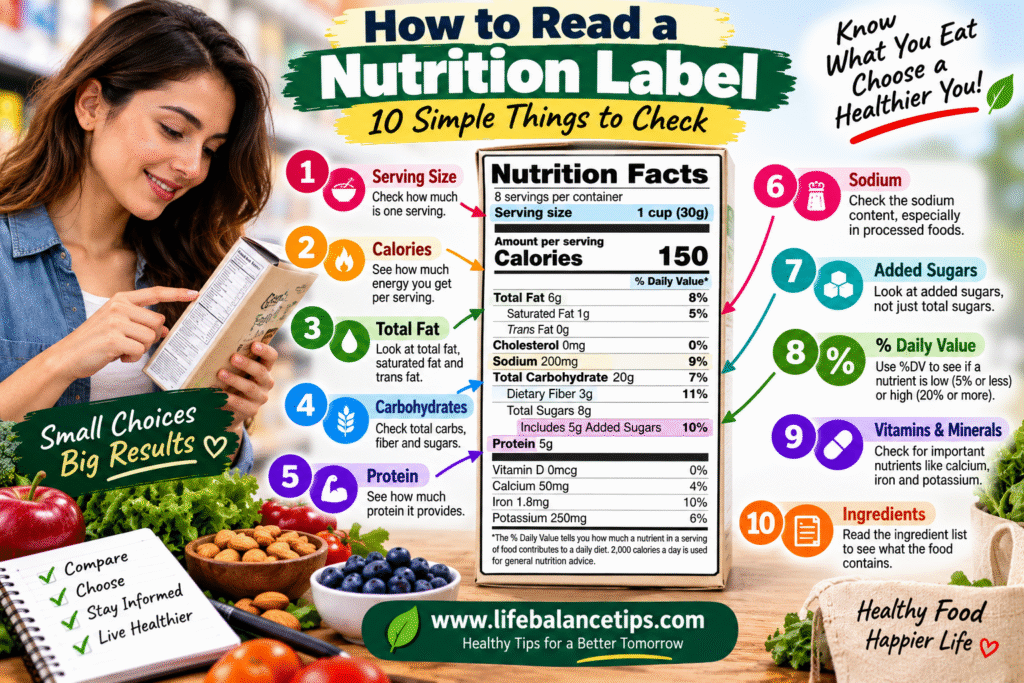
5. Understand Total Sugar vs. Added Sugar
This is one of the most useful things to learn when figuring out how to read a nutrition label for sugar.
Total Sugars
Total sugars include both:
- Naturally occurring sugars
- Added sugars
For example, milk contains naturally occurring lactose, while some flavored dairy products may contain both natural and added sugars.
Added Sugars
Added sugars are sugars added during processing or preparation.
Examples can include ingredients such as:
- Sugar
- Syrups
- Certain sweeteners
- Some concentrated fruit or vegetable juices
The FDA specifically recommends paying attention to added sugars when using the Nutrition Facts label. (U.S. Food and Drug Administration)
Simple rule
Don’t look only at the word “sugar.”
Look specifically for “Added Sugars” when that information is available.
6. Check Protein
Protein is important for maintaining and repairing body tissues and supporting normal body functions.
Foods can provide protein from sources such as:
- Eggs
- Dairy
- Fish
- Meat
- Beans
- Lentils
- Soy foods
- Nuts and seeds
When comparing similar foods, checking the protein amount can help you understand how much protein the product contributes to your diet.
However, more protein does not automatically make a food healthier. Consider the entire nutrition label and ingredient list.
7. Look at Sodium
Sodium is another number worth checking, especially when eating packaged and processed foods regularly.
Foods such as:
- Instant noodles
- Packaged soups
- Processed meats
- Sauces
- Chips
- Some ready-to-eat meals
can contribute significant amounts of sodium.
The FDA lists sodium among the nutrients consumers may want to limit. (U.S. Food and Drug Administration)
When comparing two similar products, checking the sodium amount and % Daily Value can help you make a more informed choice.
8. Learn How % Daily Value Works
The % Daily Value (%DV) can look confusing, but the basic idea is simple.
It tells you how much a nutrient in one serving contributes to a daily diet based on the Daily Value used on the label.
According to the FDA:
- 5% DV or less is generally considered low.
- 20% DV or more is generally considered high. (U.S. Food and Drug Administration)
For example, if a product has:
Sodium — 25% DV
That means one serving provides about one-quarter of the Daily Value for sodium.
You can use %DV when comparing similar products, but remember to compare products using similar serving sizes.
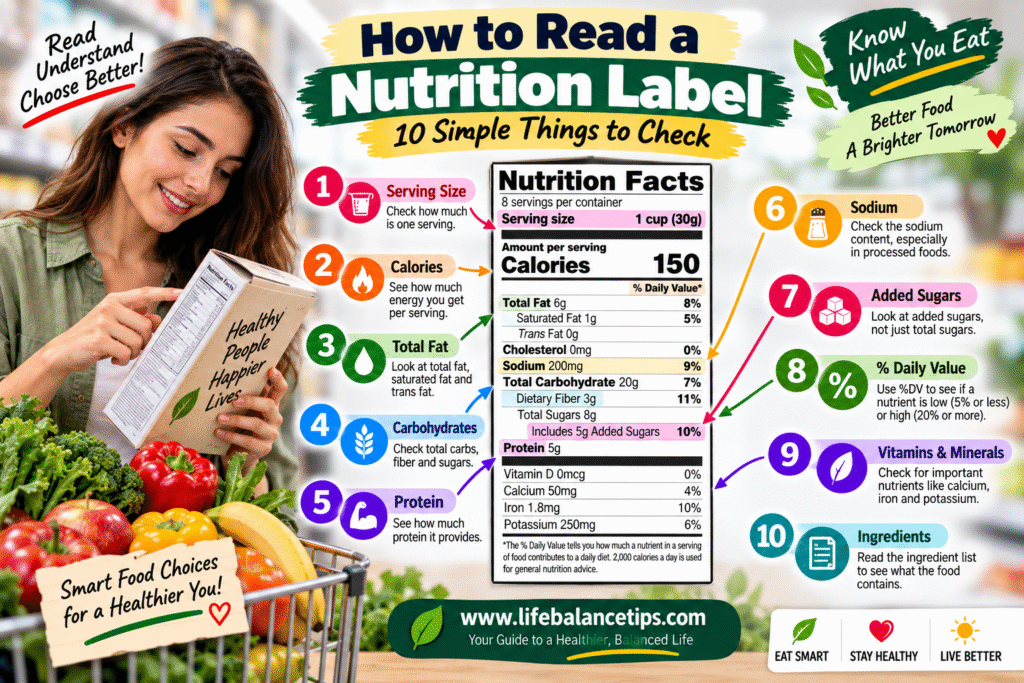
9. Read the Ingredient List
Don’t ignore the ingredient list.
It can provide useful information that the Nutrition Facts panel doesn’t show by itself.
Ingredients are generally listed in descending order by weight under U.S. labeling rules, meaning ingredients present in greater amounts are listed earlier. (U.S. Food and Drug Administration)
For example:
Ingredients:
Whole wheat flour, water, sunflower seeds, oats, sugar, salt…
The first few ingredients can tell you what makes up much of the product.
What to look for
Depending on your dietary goals, you may want to look for:
- Whole grains
- Nuts and seeds
- Beans or legumes
- Fruits or vegetables
- High-fiber ingredients
You may also want to notice whether sugar, syrups, or highly refined ingredients appear near the beginning of the list.
10. Compare Similar Products
One of the best ways to use food labels is to compare two similar products.
Suppose you’re choosing between two breakfast cereals.
| Nutrient | Cereal A | Cereal B |
| Calories | 180 | 190 |
| Protein | 5 g | 7 g |
| Fiber | 2 g | 6 g |
| Added sugar | 10 g | 5 g |
| Sodium | 220 mg | 150 mg |
Instead of choosing based only on calories, you can look at the complete picture.
Cereal B may appear more attractive if you’re specifically looking for more fiber, more protein, less added sugar, and less sodium.
This is why knowing how to read a nutrition label step by step is more useful than focusing on one number.
A Simple Nutrition Label Checklist
When you’re shopping, you don’t need to spend five minutes reading every package.
Use this quick checklist:
Before buying a packaged food, check:
1. Serving size
How much does the label consider one serving?
2. Servings per container
Could you realistically eat more than one serving?
3. Calories
How much energy does one serving provide?
4. Protein
Does it provide a useful amount for your meal or snack?
5. Fiber
Is it a good source of dietary fiber?
6. Added sugar
Is the amount high or low compared with similar products?
7. Sodium
How much sodium does one serving contain?
8. Saturated fat
Is the amount reasonable for your overall diet?
9. % Daily Value
Which nutrients are high or low?
10. Ingredients
What are the main ingredients?
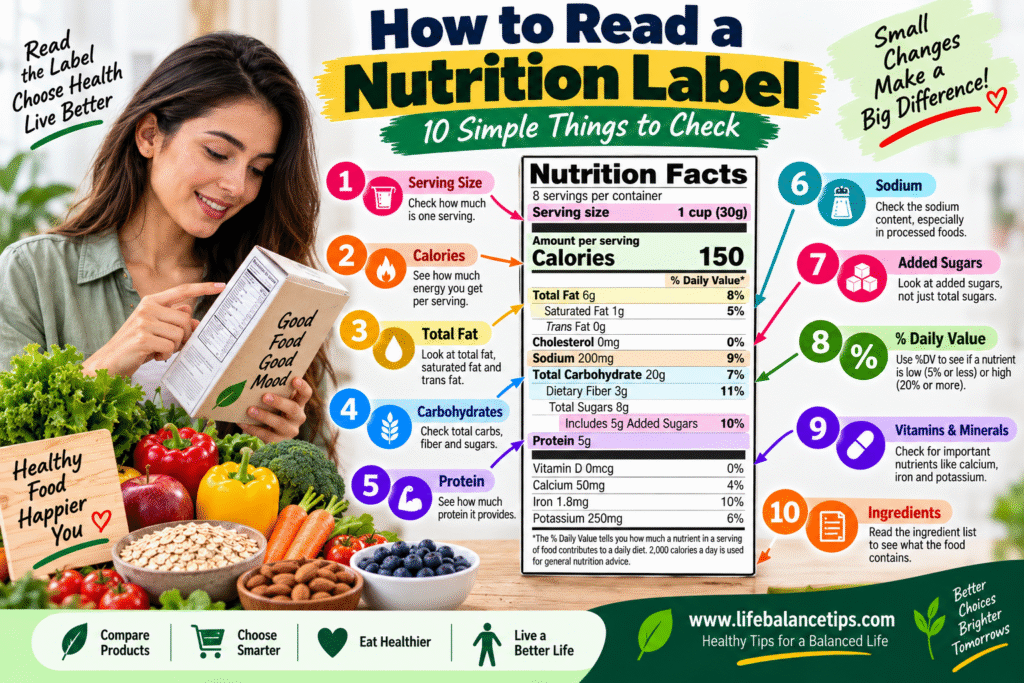
How to Read a Nutrition Label for Weight Loss
If your goal is weight management, don’t focus only on calories.
Instead, consider the whole food.
You can ask:
- What is the serving size?
- How many calories will I actually consume?
- Does the food provide protein?
- Does it provide fiber?
- Is it high in added sugar?
- Is it very high in saturated fat?
- Will this food keep me satisfied as part of my overall meal?
A food with slightly more calories may sometimes provide more protein or fiber and fit your meal better.
Your overall eating pattern matters more than one individual product.
How to Read a Nutrition Label for Diabetics
People managing diabetes may need to pay particular attention to carbohydrate information, total sugars, added sugars, fiber, and serving size.
However, individual dietary needs can vary considerably.
A useful approach is to:
- Check the serving size first.
- Look at total carbohydrate.
- Check dietary fiber.
- Check total and added sugars.
- Consider the entire meal rather than one ingredient.
- Follow the nutrition plan recommended by your healthcare professional.
If you have diabetes or another medical condition requiring a specific diet, use this information as general education rather than a replacement for individualized medical advice.
How to Read a Nutrition Label for Kids
Children have different nutritional needs from adults, so simply choosing foods based on adult calorie targets is not appropriate.
When choosing packaged foods for children, parents and caregivers can look at:
- Serving size
- Added sugar
- Sodium
- Fiber
- Protein
- Overall ingredient quality
It’s also helpful to consider what the food is replacing in the child’s diet.
A packaged snack can sometimes fit into a balanced diet, especially when combined with nutritious foods such as fruit, yogurt, vegetables, nuts, or other appropriate options.
Common Mistakes People Make When Reading Food Labels
Mistake 1: Looking Only at Calories
Calories are important, but they don’t tell you everything about a food.
Mistake 2: Ignoring Serving Size
A package may look like one serving but actually contain multiple servings.
Mistake 3: Looking Only at “Sugar”
Total sugar and added sugar are not the same.
Mistake 4: Ignoring Sodium
Some packaged foods can contain a surprisingly large amount of sodium.
Mistake 5: Believing Every Health Claim
Words such as “natural,” “light,” “multigrain,” or “healthy” don’t tell you everything about the nutritional quality of a product.
Check the actual Nutrition Facts panel and ingredient list.
Mistake 6: Comparing Different Serving Sizes
If one cereal lists nutrients per 30 g and another lists them per 50 g, the numbers aren’t directly comparable.
Try to compare equivalent amounts.
Mistake 7: Focusing on One Nutrient
A food shouldn’t be judged solely by calories, fat, sugar, protein, or any other single number.
| Label Section | What to Check | Why It Matters |
| Serving Size | Amount per serving | Helps you understand the numbers |
| Calories | Energy per serving | Helps with overall energy intake |
| Protein | Grams of protein | Supports normal body functions |
| Total Carbohydrate | Total carbs | Shows carbohydrate contribution |
| Fiber | Dietary fiber | Supports a balanced diet |
| Total Sugars | Natural + added sugars | Shows total sugar content |
| Added Sugars | Added sweeteners | Helps identify added sugar |
| Sodium | Sodium per serving | Useful when comparing packaged foods |
| Saturated Fat | Amount per serving | Useful for overall dietary choices |
| %DV | Low or high contribution | Helps compare nutrient levels |
| Ingredients | Main ingredients | Shows what the product contains |
Nutrition Label Quick Guide
A Simple Example
Imagine you are buying two packaged granola products.
Product A
- Serving size: 40 g
- Calories: 190
- Protein: 4 g
- Fiber: 3 g
- Added sugar: 10 g
- Sodium: 180 mg
Product B
- Serving size: 40 g
- Calories: 200
- Protein: 6 g
- Fiber: 6 g
- Added sugar: 5 g
- Sodium: 120 mg
Product B has slightly more calories, but it also provides more protein and fiber and less added sugar and sodium.
If those factors fit your dietary needs, Product B may be the more appealing option.
The important lesson is:
Don’t let one number make the entire decision.
5 Easy Habits for Smarter Food Shopping
1. Compare similar products
Compare cereal with cereal, yogurt with yogurt, and bread with bread.
2. Check serving size first
This prevents you from accidentally underestimating how much you’re eating.
3. Pay attention to added sugar
Especially when comparing sweetened drinks, cereals, snacks, sauces, and desserts.
4. Look for fiber
Whole grains, beans, fruits, vegetables, nuts, and seeds are common sources.
5. Read the ingredient list
Nutrition numbers and ingredients together give you a better picture of the product.
Frequently Asked Questions
1. What is the first thing to check on a nutrition label?
Start with the serving size and servings per container. The calories and nutrient amounts are generally based on the stated serving size. (U.S. Food and Drug Administration)
2. What does 20% Daily Value mean?
As a general FDA guide, 20% DV or more is considered high, while 5% DV or less is considered low. (U.S. Food and Drug Administration)
3. Is total sugar the same as added sugar?
No. Total sugars can include naturally occurring sugars as well as added sugars. Added sugars are sugars added during processing or preparation. (U.S. Food and Drug Administration)
4. How do I read a nutrition label for weight loss?
Look beyond calories. Consider serving size, protein, fiber, added sugar, saturated fat, and the overall nutritional quality of the food.
5. How do I read a nutrition label for sugar?
Check both Total Sugars and Added Sugars. Added sugar is particularly useful when comparing similar packaged products.
6. Why is serving size important?
Because the listed calories and nutrients generally refer to one serving. Eating two servings means consuming approximately twice those amounts. (U.S. Food and Drug Administration)
7. Should I avoid foods with high calories?
Not necessarily. Calorie needs differ between people, and nutritional quality matters too. Consider calories together with protein, fiber, fats, sugars, sodium, and the overall food.
8. Is the ingredient list important?
Yes. It shows what ingredients are in the product and, under U.S. labeling rules, ingredients are generally listed from greatest to least by weight. (U.S. Food and Drug Administration)
For more practical nutrition and healthy eating tips, explore our other healthy eating guides on Life Balance Tips.
For detailed guidance on understanding Nutrition Facts labels, visit the U.S. Food and Drug Administration (FDA).
Final Thoughts
Learning how to read a nutrition label doesn’t have to be complicated.
Start with the serving size, then check calories, protein, fiber, added sugar, sodium, saturated fat, % Daily Value, and the ingredient list once you practice these steps while shopping, comparing packaged foods becomes much easier.
Most importantly, don’t look for a “perfect” food label. Instead, use nutrition information to make choices that fit your overall eating pattern, preferences, and individual nutritional needs.
For more practical nutrition and healthy eating tips, explore other helpful guides on Life Balance Tips.
Health Disclaimer
This article is for general educational and informational purposes only. It is not intended to provide medical advice, diagnosis, or treatment. Individual nutrition needs vary, especially for people with diabetes, kidney disease, heart conditions, food allergies, or other health concerns. Speak with a qualified healthcare professional or registered dietitian for personalized dietary advice.
Trusted source: The U.S. Food and Drug Administration provides detailed guidance on understanding and using the Nutrition Facts label. (U.S. Food and Drug Administration)
By Life Balance Tips Team