
Grip strength is an important part of everyday fitness. It helps you carry grocery bags, open jars, hold workout equipment, lift weights, and perform many daily activities more comfortably. Whether you are a beginner, an athlete, or someone who wants to build stronger hands, improving your grip can be a useful fitness goal.
The good news is that you do not always need an expensive gym membership or specialized equipment. With consistent practice, simple exercises, and proper technique, you can work on your grip strength at home.
In this guide, you will learn how to improve grip strength, which exercises to try, how often to train, and what mistakes to avoid.
What Is Grip Strength?
Grip strength is the ability of your hands and fingers to hold, squeeze, and support an object. It involves the muscles of your hands and forearms, along with tendons and other structures that help your fingers move.
Grip strength is useful in several activities, including:
- Carrying shopping bags and luggage
- Opening bottles and jars
- Holding dumbbells and barbells
- Climbing, gardening, and other hobbies
- Performing daily tasks that require hand control
Improving grip strength may also help you hold exercise equipment more securely during strength training. However, grip training alone does not guarantee better performance in every sport or prevent injuries.
9 Exercises to Improve Grip Strength
You can start with a few basic movements and gradually increase the difficulty as your hands become more comfortable with the exercises.
1. Hand Squeezes
Hand squeezes are a simple way to begin grip training. You can use a soft stress ball or a suitable hand-grip ball.
How to do it:
- Hold a soft ball in one hand.
- Squeeze it comfortably without causing pain.
- Hold the squeeze for about 3–5 seconds.
- Slowly release your grip.
- Repeat 8–12 times, then switch hands.
Start with one or two sets. Avoid squeezing as hard as possible if your hand is not accustomed to the exercise.
2. Farmer’s Carries
Farmer’s carries train your ability to hold weights while walking. They also challenge your forearms, shoulders, and core.
How to do it:
- Choose two light dumbbells or other secure, easy-to-hold weights.
- Stand tall with one weight in each hand.
- Keep your shoulders relaxed and your wrists in a neutral position.
- Walk slowly for 15–30 seconds.
- Put the weights down carefully and rest.
Start with a weight you can control without leaning or losing your grip. Increase the duration or weight gradually rather than increasing both at once.
3. Dead Hangs
Dead hangs involve holding a secure pull-up bar while your feet are off the ground. They can challenge grip endurance, but they are not suitable for everyone.
How to do it:
- Use a properly installed pull-up bar that can safely support your weight.
- Hold the bar with both hands.
- Lift your feet only if you can do so safely.
- Find a comfortable position and breathe normally.
- Hold for a few seconds, then carefully return to the ground.
Beginners can start with a supported hang, keeping some body weight on their feet. Avoid this exercise if hanging causes shoulder, wrist, or hand pain.
4. Wrist Curls
Wrist curls strengthen the muscles that bend your wrists and support many gripping movements.
How to do it:
- Sit on a bench or chair.
- Rest your forearm on your thigh with your palm facing upward.
- Hold a light dumbbell.
- Slowly bend your wrist upward.
- Lower the weight under control.
Try 8–12 repetitions per hand for one or two sets. Use a light weight at first and avoid moving your entire forearm during each repetition.
5. Reverse Wrist Curls
Reverse wrist curls work the muscles on the upper side of your forearm. Training these muscles alongside the muscles used in regular wrist curls can help create a more balanced routine.
How to do it:
- Sit comfortably and rest your forearm on your thigh.
- Hold a light dumbbell with your palm facing downward.
- Raise the back of your hand slowly.
- Lower the dumbbell with control.
- Complete 8–12 repetitions.
Use a lighter weight than you would for regular wrist curls if necessary. Stop if you feel sharp pain.
6. Towel Wringing
Towel wringing is a convenient home exercise that uses a towel instead of weights.
How to do it:
- Take a small towel and hold one end in each hand.
- Twist the towel gently in opposite directions.
- Hold briefly, then relax.
- Reverse the direction of the twist.
- Repeat 6–10 times in each direction.
Keep the movement controlled. You do not need to twist the towel with maximum force to benefit from the exercise.
7. Plate Pinches
Plate pinches challenge your ability to hold an object using your fingers and thumb.
How to do it:
- Choose a light, secure weight plate with a suitable gripping edge.
- Hold it between your fingers and thumb.
- Keep your wrist in a comfortable position.
- Hold for 5–15 seconds.
- Lower the plate carefully and repeat.
Use a weight you can hold safely. Do not use slippery, damaged, or unstable objects, and avoid lifting a heavy plate over your feet.
8. Resistance Band Finger Extensions
Grip training should not focus only on squeezing. Finger-extension exercises work the muscles that open your hand.
How to do it:
- Place a light resistance band around your fingers.
- Start with your fingers close together.
- Gently spread your fingers against the band’s resistance.
- Hold briefly, then return to the starting position.
- Repeat 10–15 times.
Use a light band and maintain smooth movement. This exercise can complement squeezing exercises in a balanced hand routine.
9. Dumbbell Holds
Dumbbell holds are a simple exercise for building grip endurance without walking or using a pull-up bar.
How to do it:
- Pick up a light dumbbell in one hand.
- Stand upright with your arm beside your body.
- Keep your wrist straight and your shoulder relaxed.
- Hold the dumbbell for 10–20 seconds.
- Lower it safely and repeat with the other hand.
Begin with a manageable weight and increase the holding time gradually. Do not continue if your fingers start slipping or you cannot maintain a secure hold.
How to Improve Grip Strength at Home Without Equipment
You can start with a few simple movements even if you do not own dumbbells or a hand gripper.
Try these options:
- Soft-ball squeezes: Use a soft ball if you have one.
- Towel wringing: Twist a towel gently in both directions.
- Finger extensions: Spread your fingers apart and bring them together slowly.
- Controlled object holds: Hold a light, easy-to-grip household object for a short period, provided it is safe and not slippery.
Household exercises can be useful starting points, but progressive resistance is generally more effective for continued strength development. As your grip improves, you may need a suitable resistance band, hand gripper, or light weights to keep progressing.
Beginner Grip Strength Workout Plan
If you are new to grip training, begin with two sessions per week and allow recovery between sessions.
| Exercise | Starting amount |
| Hand squeezes | 1–2 sets of 8–12 reps |
| Wrist curls | 1 set of 8–12 reps per hand |
| Reverse wrist curls | 1 set of 8–12 reps per hand |
| Towel wringing | 6–10 twists per direction |
| Finger extensions | 1–2 sets of 10–15 reps |
Choose only the exercises you can perform comfortably. You do not have to complete every exercise in one session.
Rest between sets as needed. If your hands and forearms remain unusually sore, reduce the number of sets or take more recovery time.
How Often Should You Train Grip Strength?
For many beginners, two or three short sessions per week can be a reasonable starting point. Your ideal frequency depends on your fitness level, the intensity of the exercises, and other activities such as weightlifting or climbing.
Keep these tips in mind:
- Allow recovery time between challenging sessions.
- Increase resistance or duration gradually.
- Avoid training through pain.
- Reduce grip training if your forearms are already fatigued from other workouts.
- Focus on consistent technique rather than doing as many repetitions as possible.
You may notice that exercises feel easier after several sessions, but the time required to develop measurable strength varies from person to person.
Common Grip Training Mistakes to Avoid
Avoiding common mistakes can help you train more comfortably and consistently.
Using too much weight: Heavy weights can make it difficult to maintain a secure grip and proper form. Start light and progress gradually.
Training every day at maximum effort: Your hands and forearms need time to recover, especially after challenging holds or squeezing exercises.
Ignoring the opposite muscles: Include gentle finger-extension work alongside gripping exercises.
Using poor technique: Keep your wrists in a comfortable position and avoid jerking or swinging weights.
Ignoring pain or numbness: Stop an exercise that causes sharp pain, tingling, numbness, or unusual weakness. Seek medical advice if symptoms persist or recur.
What Else Can Help Improve Grip Strength?
Exercise is the main way to train your grip, but a few general habits can support your progress.
Eat a Balanced Diet
Include protein-rich foods such as eggs, beans, lentils, yogurt, fish, tofu, or lean meat, depending on your dietary preferences. Protein helps support muscle repair and growth as part of an overall balanced diet.
Get Enough Sleep
Adequate sleep supports recovery from physical activity. Try to maintain a consistent sleep schedule that allows you to feel rested.
Increase Difficulty Gradually
When an exercise becomes comfortable, increase one factor slightly, such as the holding time, number of repetitions, or resistance. Do not make large increases all at once.
Be Consistent
Short, regular sessions are often easier to maintain than occasional intense workouts. Track your repetitions or holding time so you can see your progress.
Frequently Asked Questions
1. How can I improve grip strength quickly?
Start with manageable exercises such as hand squeezes, dumbbell holds, and towel wringing. Practice consistently, allow time for recovery, and gradually increase the difficulty. Strength improvements vary between individuals.
2. How can I improve grip strength at home?
You can practice towel wringing, finger extensions, and soft-ball squeezes at home. If you have suitable equipment, light dumbbell holds and wrist curls are additional options.
3. Do hand grippers really work?
Hand grippers can help develop crushing grip strength when used with appropriate resistance and consistent training. Choose a resistance you can control and avoid repeatedly squeezing through pain.
4. How often should beginners train grip strength?
Two or three sessions per week can be a reasonable starting point for many beginners. Allow recovery between challenging sessions and adjust your routine if you also lift weights or perform other activities that heavily use your hands.
5. Does grip strength help with weightlifting?
Yes, grip strength can help you hold dumbbells, barbells, and other equipment. However, technique, overall strength, and exercise-specific practice also matter.
6. Can I improve grip strength without equipment?
Yes. Towel wringing, finger extensions, and controlled hand exercises can be starting options. Over time, you may need additional resistance to continue making progress.
7. When should I see a healthcare professional about weak grip?
Seek medical advice if you notice sudden or unexplained weakness, persistent pain, numbness, tingling, or a significant difference between your hands. Sudden weakness, especially with facial drooping or difficulty speaking, requires emergency medical attention.
Conclusion
Learning how to improve grip strength does not have to be complicated. Hand squeezes, farmer’s carries, wrist curls, towel wringing, and dumbbell holds are practical exercises that can help you build stronger hands and forearms over time.
Start with a few comfortable movements, train consistently, and increase resistance gradually. Remember that recovery and proper technique are just as important as the exercises themselves. If an activity causes pain, stop and seek appropriate guidance before continuing.
Disclaimer: This article is for general educational purposes only and is not a substitute for individualized medical advice. Choose exercises that match your ability and consult a qualified healthcare professional if you have an existing hand, wrist, or shoulder condition.
SEO Details
SEO Title: How to Improve Grip Strength: 9 Easy Exercises
Focus Keyword: how to improve grip strength
Permalink: how-to-improve-grip-strength
Meta Description: Learn how to improve grip strength with 9 simple exercises, beginner-friendly home workouts, and practical tips for stronger hands and forearms.
Excerpt: Discover 9 simple exercises to improve grip strength at home, build stronger hands and forearms, and support everyday activities and weightlifting.
Category: Fitness & Exercise
Tags: how to improve grip strength, grip strength exercises, grip strength workout, improve grip strength at home, hand strengthening exercises, forearm strengthening exercises, grip training for beginners, wrist strengthening exercises, farmer’s carries, hand grip exercises
Featured Image Alt Text:
Featured Image Title: How to Improve Grip Strength
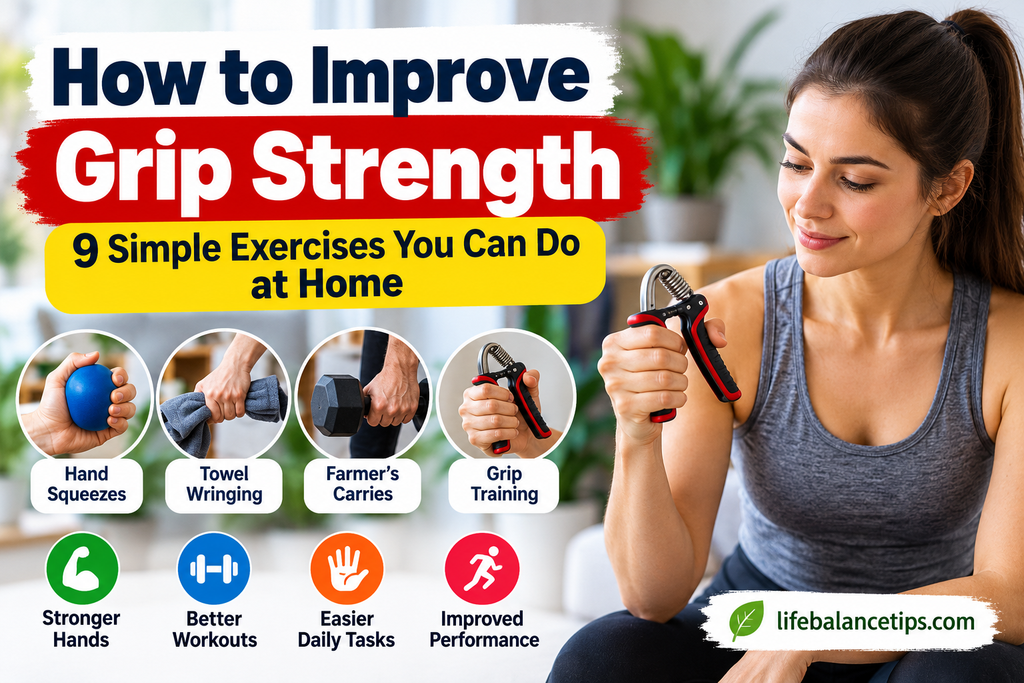
Featured Image Caption: Simple exercises can help improve grip strength and build stronger hands and forearms.
Featured Image Description: A fitness-themed image illustrating grip strength training with dumbbells and hand-strengthening exercises for beginners.
Suggested Featured Image Prompt: Create a clean, realistic fitness blog featured image in a bright home workout setting. Show a person performing a controlled dumbbell hold to demonstrate grip-strength training, with a soft stress ball, resistance band, and towel subtly visible in the background. Use a modern, encouraging, beginner-friendly style with natural lighting, neutral colors, and clear space for the title “How to Improve Grip Strength.” Avoid exaggerated muscles, unsafe exercise form, clutter, logos, and extra text.
Suggested Internal Link: Add a relevant link to an existing article on your website about strength training, exercise, or healthy fitness habits, if you have one.
Suggested External Reference: For evidence-based physical activity guidance, link to the official U.S. Physical Activity Guidelines.