
Published: September 22, 2026
The U.S. Food and Drug Administration (FDA) has released the 2026 Food Code, providing updated model provisions intended to help protect food safety in restaurants, grocery stores, food-service operations, vending establishments, and other retail food settings.
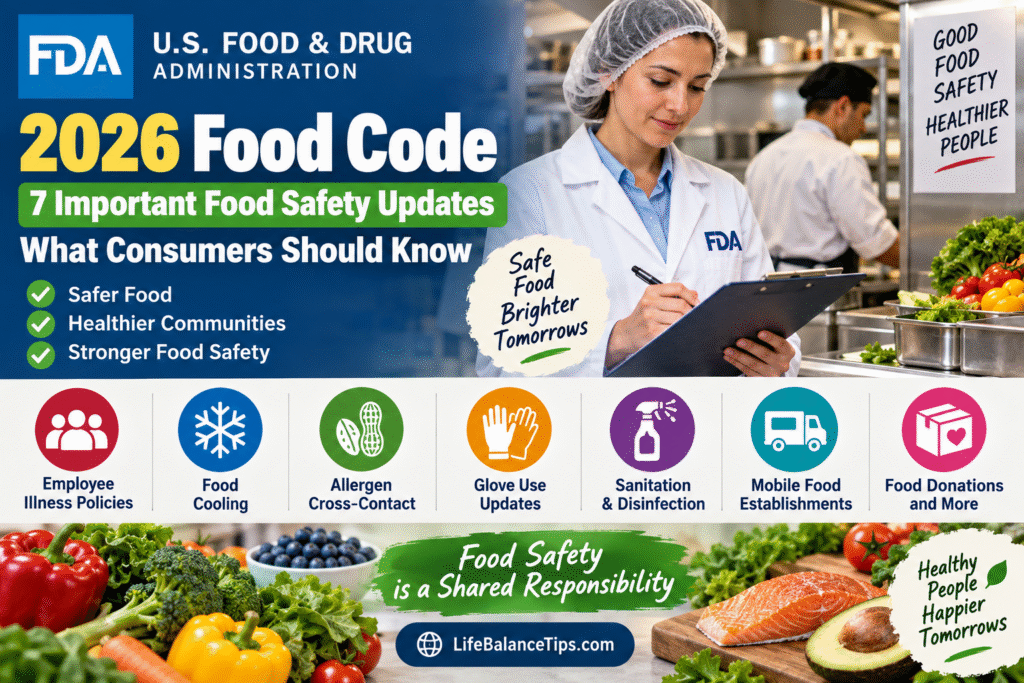
The new edition was released on September 17, 2026. It includes updates involving employee illness policies, food cooling, allergen cross-contact, glove use, sanitation, mobile food establishments, food donations, and several other food-safety areas.
The 2026 Food Code is important because food safety rules can affect how food is handled, prepared, stored, cooled, served, and inspected.
However, there is an important point consumers should understand: the FDA Food Code is a model code, not automatically a federal law that applies identically to every restaurant or food establishment. State, local, tribal, and territorial regulators can adopt or modify the model provisions through their own laws and regulations.
Here is a simple explanation of the latest changes and what they may mean for consumers.
What Is the 2026 Food Code?
The FDA Food Code is a model set of food-safety provisions developed by the FDA to help regulatory authorities create or update rules for retail food and food-service establishments.
These establishments can include restaurants, grocery stores, schools, hospitals, nursing homes, childcare facilities, vending operations, and other places where food is prepared or sold to consumers.
The 2026 Food Code is the latest full edition released by the FDA.
Its purpose is to provide a more consistent, science-based framework for reducing food-safety risks and helping regulators and food businesses apply food-safety practices.
The FDA says the code has been widely adopted by jurisdictions that regulate more than one million restaurants, retail food stores, vending operations, and food-service operations.
Why Did the FDA Release a New Food Code?
Food safety practices can change as scientific knowledge, technology, food preparation methods, and industry practices develop.
The FDA updates the Food Code to reflect changes in food-safety science, regulatory practices, and emerging industry trends.
The 2026 edition was developed with input from regulatory officials, industry representatives, academics, and consumers who participated in the Conference for Food Protection process. The FDA also works with organizations including the USDA Food Safety and Inspection Service, CDC, and EPA on food-safety issues.
7 Important 2026 Food Code Updates
1. Written Employee Illness Policies
One notable change in the 2026 Food Code is a new requirement involving written employee illness policies.
Food establishments are expected to maintain and make available written policies addressing employee illness. This is intended to provide clearer procedures for managing food employees who may have illnesses that could create a food-safety risk.
Why does this matter?
Food employees can come into contact with food, utensils, equipment, and food-contact surfaces. Clear illness policies can help businesses establish consistent procedures for reducing the possibility of food contamination.
For consumers, this is mainly a food-establishment management issue rather than something they need to implement at home.
2. Alternative Food Cooling Process
The FDA also added an alternative cooling process for certain foods at retail establishments.
Proper cooling is an important part of food safety because some foods can become unsafe if they remain at temperatures that allow harmful microorganisms to grow.
The 2026 Food Code provides an alternative cooling process while maintaining food-safety controls.
For consumers, this highlights why restaurants and other food establishments need appropriate temperature-control procedures when preparing foods ahead of service.
At home, people should also follow reliable food-storage and cooling guidance rather than leaving cooked foods at room temperature for extended periods.
3. Changes Related to Food Employee Glove Use
The 2026 Food Code includes an exception that allows double gloving under specific circumstances.
The change is part of broader updates related to food employee practices and food handling.
Gloves can be useful in food preparation, but wearing gloves does not automatically make food handling safe.
Employees still need to follow appropriate handwashing and food-handling practices. Gloves can also become contaminated if they are used improperly or touched against contaminated surfaces.
The important point for consumers is that food safety depends on the complete food-handling process, not simply whether an employee is wearing gloves.
4. More Attention to Allergen Cross-Contact
Another area addressed in the 2026 Food Code is allergen cross-contact.
Food allergies can be serious, and accidental contact between an allergen-containing food and another food can create a risk for people with allergies.
The new Food Code provides clarification related to allergen cross-contact and food-safety practices.
For consumers with food allergies, communication remains important.
When eating at a restaurant, customers with allergies should clearly communicate their allergy to restaurant staff and ask questions about ingredients and preparation procedures.
A person with a serious food allergy should continue following advice from their healthcare professional.
5. Updates to Sanitation and Disinfection
The 2026 edition also addresses sanitation-related areas, including sanitizer temperatures and disinfection of equipment and utensils.
Proper cleaning and sanitizing are important because food-contact surfaces can become contaminated during preparation.
Restaurants and other food establishments need procedures for cleaning and sanitizing equipment, utensils, and surfaces appropriately.
Consumers generally will not see these procedures directly, but they are an important part of safe food preparation behind the scenes.
6. Updates for Mobile Food Establishments
The new 2026 Food Code adds a definition for “Mobile Food Establishment.”
This is relevant as food trucks and other mobile food businesses continue to be an important part of the food-service industry.
The updated code also addresses issues involving mobile food establishments and other food-service operations.
The goal is to provide regulators with clearer model provisions for different types of food businesses.
Consumers can still use the same basic food-safety principles when choosing food from a mobile establishment: consider cleanliness, food handling, temperature control, and the overall condition of the operation.
7. More Food-Safety Guidance for Specialized Food Processes
The 2026 Food Code also includes updates involving specialized food processes.
These include areas such as sushi rice acidification, dehydration, and freeze-drying. The code also addresses specialty mushroom hazards, vending machine controls, food donations, waste receptacles, and other food-safety matters.
These changes are particularly relevant to food businesses and regulators because specialized preparation methods can involve specific food-safety considerations.
For ordinary consumers, the main takeaway is that different preparation methods may require different food-safety controls.
What Does the 2026 Food Code Mean for Restaurant Customers?
The 2026 Food Code is primarily a regulatory and food-industry resource.
Consumers do not need to memorize the new provisions.
Instead, the changes provide a useful reminder that food safety involves several steps, including:
- Proper food handling
- Appropriate temperature control
- Good personal hygiene
- Safe storage
- Cleaning and sanitizing
- Allergen management
- Appropriate employee illness policies
- Safe preparation procedures
The FDA describes the Food Code as a model that helps regulatory jurisdictions establish or update food-safety rules.
Therefore, the exact requirements a restaurant must follow can depend on the rules adopted by the relevant state or local authority.
Is the 2026 Food Code a New Federal Law?
No.
This is an important distinction.
The FDA Food Code is a model code. It provides recommendations and model provisions for jurisdictions that regulate retail food and food-service establishments.
The FDA states that the Food Code is not required by itself, although it has been widely adopted by state, local, tribal, and territorial agencies.
This means that publication of the 2026 Food Code does not automatically mean that every restaurant in the United States immediately has to follow every provision.
Individual jurisdictions may adopt the model code through their own legal and regulatory processes.
Why Food Safety Matters at Restaurants
Foodborne illness can occur when food becomes contaminated or is improperly handled.
Food safety practices are designed to reduce these risks.
Important areas include temperature control, preventing cross-contamination, employee hygiene, cleaning and sanitizing, proper food storage, and appropriate handling of foods that can cause allergic reactions.
The FDA says widespread adoption and implementation of the Food Code can help reduce foodborne illness risk and create more standardized food-safety approaches.
The 2026 update therefore provides regulators and food businesses with a newer framework for addressing food-safety risks.
What Can Consumers Do to Protect Food Safety?
Although most Food Code changes are directed toward businesses and regulators, consumers can also follow simple food-safety habits.
Choose Food From Clean Establishments
When possible, choose restaurants and food businesses that appear clean and well-maintained.
Look at general cleanliness around food preparation and dining areas.
Pay Attention to Food Temperature
Foods that need refrigeration should be kept appropriately cold, while hot foods should be served and held safely.
If a food looks or smells unusual, it may be better not to eat it.
Ask About Allergens
If you have a food allergy, tell restaurant staff clearly.
Ask about ingredients and preparation practices when necessary.
For severe allergies, follow the safety plan provided by your healthcare professional.
Wash Your Hands
Handwashing remains one of the simplest ways to reduce the spread of germs.
Wash your hands before eating and after situations where your hands may become contaminated.
Store Leftovers Properly
At home, store perishable leftovers promptly and use appropriate refrigeration and reheating practices.
If you are unsure about the safety of a particular food, consult official food-safety guidance rather than relying only on smell or appearance.
What the New Food Code Does Not Mean
News about regulatory updates can sometimes sound more dramatic than the actual change.
The 2026 Food Code does not mean that all restaurants suddenly have completely new rules on the same day.
Instead, it provides a model framework that jurisdictions can adopt, modify, or use when updating their own food-safety regulations.
The code also does not guarantee that every food establishment will follow every provision perfectly.
Food-safety oversight involves regulators, food businesses, employees, and consumers.
2026 Food Code and Food Safety Management
Another important area in the new edition is food safety management.
The 2026 edition includes definitions and provisions related to food safety management systems and food defense.
A food safety management approach focuses on preventing problems rather than simply reacting after a problem occurs.
For food establishments, this can involve identifying potential hazards, establishing controls, monitoring important procedures, and taking corrective action when necessary.
For consumers, the practical takeaway is simple: food safety works best when it is treated as a continuous process.
What About Food Donations?
The 2026 Food Code also addresses food donations.
Food donation can help reduce food waste and make food available to people who need it, but donated food still needs to be handled safely.
The updated Food Code includes provisions addressing food donations as part of its broader food-safety framework.
The goal is to support food safety while addressing different circumstances in which food may be distributed.
Key Takeaways
Here are the most important points about the new 2026 Food Code:
- The FDA released the 2026 edition on September 17, 2026.
- It is the latest full edition of the FDA Food Code.
- It provides model food-safety provisions for retail and food-service establishments.
- It includes new provisions related to written employee illness policies.
- It introduces an alternative cooling process for certain foods at retail.
- It includes changes involving glove use and allergen cross-contact.
- It addresses sanitation, disinfection, mobile food establishments, food donations, vending operations, and specialized food processes.
- It is a model code and is not automatically a federal law that applies identically everywhere.
For more practical healthy eating information, explore our guide to 10 Healthy Food Swaps for a Healthier Everyday Diet.
Frequently Asked Questions
What is the 2026 Food Code?
The 2026 Food Code is the latest full edition of the FDA’s model food-safety provisions for retail food and food-service establishments.
When was the 2026 Food Code released?
The FDA released the 2026 edition on September 17, 2026.
Does the 2026 Food Code apply to every restaurant?
Not automatically. It is a model code that jurisdictions can adopt or use when developing their own food-safety rules.
What are some major changes in the 2026 Food Code?
Updates include written employee illness policies, an alternative cooling process, changes involving double gloving, allergen cross-contact clarification, sanitation and disinfection provisions, mobile food establishment definitions, and other food-safety updates.
Does the Food Code apply to food trucks?
The 2026 edition includes a definition for mobile food establishments and provisions relevant to these operations. The exact requirements depend on the jurisdiction that regulates the business.
Why are employee illness policies important?
Written illness policies can help food establishments manage situations in which an employee’s illness could create a food-safety risk.
Does the new Food Code change food safety at home?
The Food Code is primarily intended for retail and food-service establishments. However, its updates reinforce general principles such as proper food handling, temperature control, sanitation, and preventing contamination.
Where can I read the official 2026 Food Code?
The FDA provides the official 2026 Food Code and related resources on its website.
Final Thoughts
The FDA’s new 2026 Food Code provides updated model provisions designed to support food safety in restaurants, retail food stores, food-service operations, and other food establishments.
The update covers many areas, from employee illness policies and cooling procedures to allergen cross-contact, sanitation, mobile food establishments, and specialized food preparation.
For consumers, the most useful takeaway is that food safety depends on many steps working together. Clean handling, appropriate temperatures, good hygiene, allergen awareness, and proper storage can all play a role in reducing food-safety risks.
Because the Food Code is a model rather than an automatically applicable federal law, consumers should also understand that specific requirements can vary depending on the jurisdiction.
Source
This article is based primarily on information published by the U.S. Food and Drug Administration (FDA).
Official source: FDA — The 2026 Food Code
Health Disclaimer
This article is for general educational and informational purposes only. It is not medical advice and does not diagnose, treat, or prevent any disease. Food-safety requirements can vary by location. For specific food-safety, allergy, or health concerns, consult the appropriate government authority or a qualified healthcare professional.