
Maintaining a healthy body composition becomes increasingly important as people grow older. Losing excess body fat can support overall health, but preserving muscle is equally important for strength, balance, mobility, and everyday independence.
A recent report highlights research on how different exercise intensities affect body fat and lean mass in older adults. The study suggests that HIIT for older adults may help reduce body fat while maintaining lean tissue.
HIIT stands for high-intensity interval training. It involves alternating short periods of challenging exercise with easier recovery periods. Although this type of workout is often associated with younger athletes, researchers are also investigating its potential role in healthy aging.
However, the findings need to be understood carefully. The research involved healthy older adults exercising under supervision, and the differences between exercise groups were relatively small. HIIT is also not appropriate for everyone.
In this article, we will explain seven important study findings, how interval training works, what beginners should know, and how older adults can approach exercise safely.
What Is HIIT for Older Adults?
High-intensity interval training combines periods of more demanding movement with periods of lower-intensity recovery.
For example, a person might pedal a stationary bicycle at a challenging pace for a short interval and then pedal slowly to recover. The pattern is repeated for a planned number of rounds.
The exact intensity, duration, and exercise type depend on a person’s fitness and health. In a supervised program, an exercise professional may adjust the workload using heart-rate measurements and the participant’s response to exercise.
The term HIIT for older adults does not mean that every older person should immediately perform all-out sprints or exhausting workouts. Higher-intensity training should be adapted to the individual, and some people may benefit more from walking, moderate aerobic exercise, strength training, or a combination of these activities.
The goal is to choose exercise that supports health without creating unnecessary risk.
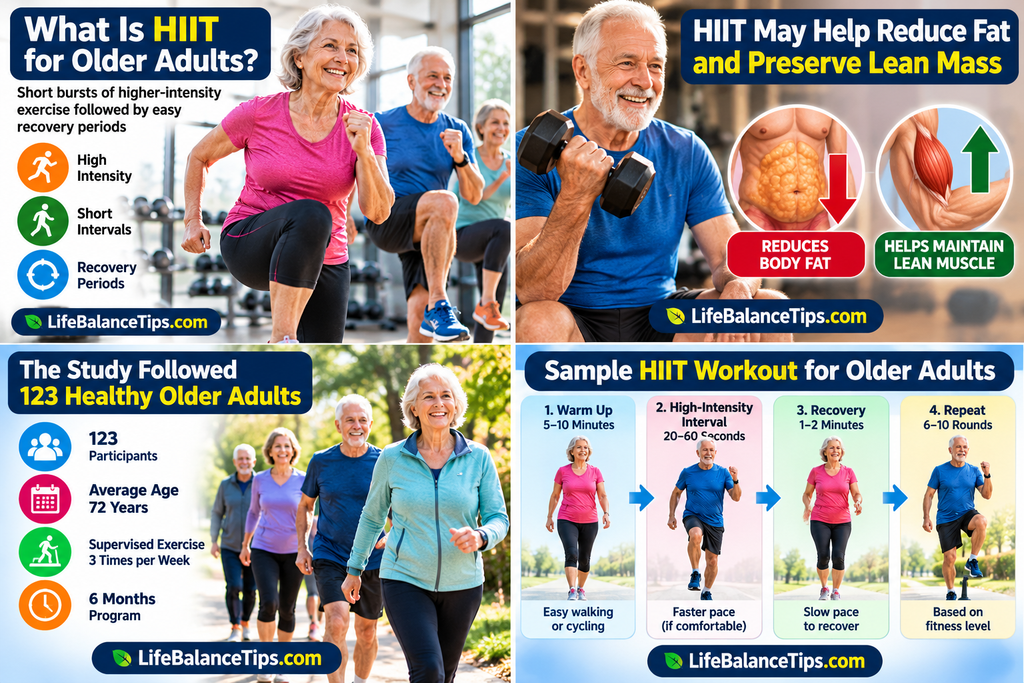
1. The Study Followed 123 Healthy Older Adults
The research, published in the journal Maturitas, compared high-intensity interval training, moderate-intensity exercise, and a low-intensity active control condition.
The study included 123 apparently healthy older adults with an average age of approximately 72 years. Participants completed supervised, treadmill-based exercise sessions lasting 45 minutes, three times per week, for six months.
The groups were assigned as follows:
- High-intensity interval training: 41 participants.
- Moderate-intensity training: 45 participants.
- Low-intensity active control: 37 participants.
Researchers assessed body composition at the beginning of the study and at later measurement points. They used dual-energy X-ray absorptiometry, commonly called DXA, to measure body composition.
This design allowed the researchers to compare how different exercise intensities were associated with changes in fat mass and lean mass over time.
The findings are especially relevant because aging can involve gradual changes in muscle and body fat. Nevertheless, the study’s participants were healthy older adults, so the results should not automatically be applied to people with significant medical conditions or mobility limitations.
Read the original study: Exercise intensity influences body composition in healthy older adults — Maturitas.
2. HIIT Reduced Body Fat While Preserving Lean Mass
One of the most notable findings was that the high-intensity group reduced fat mass without experiencing the same decline in lean mass observed in the moderate-intensity group.
This distinction matters because weight loss does not always mean that a person has lost only body fat. Changes in body weight can include changes in fat, muscle, water, and other lean tissues.
Maintaining lean mass can be important for older adults because muscle supports everyday activities such as climbing stairs, carrying groceries, standing up from a chair, and walking safely.
The study suggests that HIIT for older adults may be one useful exercise option when improving body composition is a goal.
However, DXA measures lean tissue, not muscle strength directly. Lean mass includes more than skeletal muscle, and a change in lean mass does not translate perfectly into a change in strength or physical function.
The findings also do not mean that every older adult will lose fat or preserve muscle when doing HIIT. Individual results depend on several factors, including starting fitness, nutrition, health, training consistency, and recovery.
3. Moderate-Intensity Exercise Also Reduced Fat
The research did not show that moderate-intensity exercise was ineffective.
Both the high-intensity and moderate-intensity groups experienced reductions in fat mass that were greater than those in the low-intensity control group.
The difference was in how the groups changed in lean mass. The moderate-intensity group experienced a small reduction in fat-free mass, whereas the HIIT group did not show the same decline.
This is an important distinction: moderate exercise can still be useful for improving fitness and body composition.
For people who are new to exercise, have limited stamina, or feel uncomfortable with intense movement, moderate activity may be a more practical starting point. Brisk walking, comfortable cycling, water-based exercise, and other suitable activities can help build a consistent routine.
The findings on HIIT for older adults should therefore be viewed as a comparison between specific supervised exercise programs, not as proof that moderate exercise is inferior for every health outcome.
Exercise choice should take into account the person’s goals, preferences, abilities, and medical circumstances.
4. Exercise Intensity May Influence Body Composition
Why might exercise intensity make a difference?
Different exercise intensities place different demands on the body. Challenging intervals may stimulate physiological adaptations that differ from those produced by easier or steadier exercise.
Researchers suggested that higher-intensity training may provide a stronger stimulus for maintaining lean tissue while reducing fat mass. However, the study did not establish every biological mechanism responsible for the observed differences.
It is also important to remember that intensity is only one part of a successful exercise program. Consistency, recovery, nutrition, sleep, and the ability to perform movements safely also matter.
A workout that is too difficult to repeat consistently may be less useful in everyday life than an activity a person can comfortably maintain.
For older adults considering HIIT for older adults, the practical lesson is to focus on an appropriate level of challenge rather than assuming that harder exercise always produces better results.
A qualified exercise professional can help determine whether intervals are suitable and how to progress gradually.
5. The Study Also Examined Abdominal Fat
The researchers reported improvements in visceral adipose tissue in both the high-intensity and moderate-intensity groups.
Visceral fat is stored deep within the abdomen around internal organs. It differs from the fat located directly beneath the skin.
Excess visceral fat is associated with several health risks, although body-fat distribution and health outcomes are influenced by many factors.
The study’s findings suggest that both high- and moderate-intensity exercise may support improvements in this aspect of body composition among healthy older adults.
It would be inaccurate to claim that HIIT specifically melts belly fat or guarantees a smaller waist. People cannot reliably choose exactly where their bodies lose fat through a particular exercise.
Changes in body composition also vary between individuals. Exercise is only one part of the picture, alongside dietary habits, sleep, medications, genetics, and other health factors.
For most people, a sustainable approach that combines suitable physical activity with balanced nutrition is more realistic than trying to target one specific area of the body.
6. Preserving Muscle Matters During Healthy Aging
Muscle supports more than appearance or athletic performance. It helps people carry out routine tasks, maintain posture, move confidently, and remain independent.
As people age, muscle strength and mass may decline for several reasons, including reduced activity, illness, inadequate nutrition, and normal age-related changes.
That is why exercise plans for older adults should consider both aerobic fitness and muscle strength.
Aerobic activities can support heart and lung fitness, while appropriate resistance exercises can help maintain strength. Balance exercises may also be important for people who are at risk of falls.
The research on HIIT for older adults contributes to the discussion about how exercise programs can improve body composition without unnecessarily reducing lean tissue.
However, the study was not a complete test of every type of exercise, and it does not establish that HIIT is the best choice for strength, balance, fall prevention, or all aspects of healthy aging.
A balanced program should reflect the individual’s needs rather than focus on a single measurement.
Maintaining muscle strength is an important part of healthy aging. Explore our guide to the best foods for muscle health and learn how balanced nutrition can support stronger muscles.
7. The Results Were Promising but Relatively Small
The study offers useful information, but it has limitations.
First, the participants were healthy older adults. People with heart disease, significant joint problems, balance difficulties, or other medical conditions may respond differently to intense exercise.
Second, the program was supervised. The results cannot automatically be applied to unsupervised workouts performed at home without guidance.
Third, changes in lean mass were relatively small and were not necessarily clinically meaningful. The researchers noted that the results should be interpreted in light of measurement error and the modest differences between groups.
Finally, the study examined body composition over six months. It does not prove that HIIT prevents disability, extends life, or produces superior long-term health outcomes compared with every other exercise approach.
The best interpretation is that supervised high-intensity interval training may be a useful option for some healthy older adults when the goal is to improve body composition.
More research can help clarify which people benefit most, how programs should be adapted, and whether the observed differences translate into meaningful improvements in everyday function.
How Can Older Adults Approach HIIT Safely?
High-intensity exercise can be demanding. Older adults should not begin with maximal effort simply because a study reported promising results.
Start With Your Current Fitness Level
If you have not exercised regularly, begin with manageable activities such as comfortable walking or gentle cycling. Build consistency before considering more demanding intervals.
Ask a Healthcare Professional When Needed
People with cardiovascular disease, uncontrolled blood pressure, significant joint pain, dizziness, balance problems, or other medical concerns should seek professional advice before starting a high-intensity program.
Consider Supervision
A qualified exercise professional can help select suitable movements, adjust intensity, and monitor how you respond. Supervision is particularly valuable when learning a new training method.
Warm Up Before Exercise
Begin with several minutes of easy movement to prepare your body. Finish with a gradual cool-down rather than stopping suddenly after a demanding interval.
Progress Gradually
Increase intensity or duration in small steps. Avoid jumping straight into all-out intervals or copying an advanced athlete’s workout.
Stop if You Experience Warning Symptoms
Stop exercising and seek appropriate medical assistance if you develop chest pain, faintness, severe or unusual shortness of breath, or other concerning symptoms. Sudden or severe symptoms may require emergency care.
The safest version of HIIT for older adults is one adapted to the person’s current abilities and medical needs.
A Beginner-Friendly Alternative to Intense Intervals
People who are not ready for HIIT can still build an active routine. The following example is a general illustration, not the exact protocol used in the study.
| Stage | Example activity | Purpose |
| Warm-up | Easy walking or cycling | Prepare gradually |
| Comfortable interval | A few minutes of movement at an easy pace | Build consistency |
| Slightly faster interval | A brief increase in pace, if comfortable | Introduce a manageable challenge |
| Recovery | Return to an easy pace | Allow breathing to settle |
| Cool-down | Slow walking and gentle movement | Finish gradually |
Beginners can remain at a comfortable pace rather than adding faster intervals. People with balance or mobility limitations may need seated or supported activities.
There is no need to push through pain or exhaustion to make exercise worthwhile.
Nutrition and Recovery Also Matter
Exercise alone does not determine body composition. Adequate nutrition and recovery are important, particularly for older adults trying to preserve muscle.
Eat Balanced Meals
Include a variety of vegetables, fruits, whole grains, and suitable protein sources. Individual nutritional needs vary, especially for people with kidney disease or other conditions requiring dietary adjustments.
Get Enough Protein for Your Needs
Protein supports the maintenance and repair of body tissues. The amount a person needs depends on age, activity, medical conditions, and other factors. A healthcare professional or registered dietitian can help determine an appropriate intake.
Allow Time for Recovery
Hard exercise should be balanced with recovery. Pay attention to fatigue, soreness, sleep, and how you feel the following day.
Stay Hydrated
Drink fluids regularly and pay attention to hydration during exercise, particularly in hot weather. People who have been advised to restrict fluids should follow their healthcare professional’s guidance.
Avoid Extreme Weight-Loss Plans
Rapid weight loss and restrictive diets can make it harder to meet nutritional needs. Older adults should prioritize strength, mobility, and overall health rather than focusing only on the number on the scale.
Frequently Asked Questions
1. What is HIIT for older adults?
HIIT is high-intensity interval training, which alternates challenging periods of exercise with easier recovery periods. For older adults, the workout should be adapted to fitness level, health status, and physical abilities.
2. Can HIIT help older adults lose fat without losing muscle?
A six-month study of 123 healthy older adults found that the HIIT group reduced fat mass without the same decline in lean mass observed in the moderate-intensity group. The changes were relatively small, and the results do not guarantee the same outcome for everyone.
3. Is HIIT better than walking for older adults?
Not necessarily. The study compared specific supervised exercise programs, not every possible walking routine. Walking can be an accessible and valuable activity, particularly for people who are new to exercise or cannot safely perform intense intervals.
4. How often should older adults do HIIT?
There is no single schedule suitable for everyone. The study used three supervised 45-minute exercise sessions per week, but that does not mean all older adults should copy this schedule. A suitable plan depends on health, fitness, intensity, and recovery.
5. Is HIIT safe for people over 65?
Age alone does not determine whether HIIT is safe. Some healthy older adults may be able to participate in adapted, supervised programs, while others may need lower-intensity activities. People with medical conditions or symptoms should seek professional advice before beginning.
6. Can HIIT reduce belly fat?
The study found improvements in visceral adipose tissue in both high- and moderate-intensity groups. However, HIIT cannot guarantee a reduction in belly fat for every person, and people cannot choose exactly where body fat is lost.
7. What is the best exercise for maintaining muscle as you age?
The most suitable exercise plan depends on individual needs. Appropriate strength training, aerobic activity, balance exercises, and adequate nutrition can all play a role. A qualified professional can help create a safe and sustainable routine.
Conclusion
Research published in Maturitas suggests that high-intensity interval training may help some healthy older adults reduce body fat while maintaining lean mass. In the six-month study, both high- and moderate-intensity exercise reduced fat mass, but the HIIT group did not experience the same decline in lean mass seen in the moderate-intensity group.
These findings make HIIT for older adults an interesting topic in healthy-aging research, but they do not establish that intense exercise is best for everyone. The changes were modest, participants were healthy older adults, and the sessions were supervised.
Older adults who want to become more active should choose a routine that matches their abilities, progress gradually, and seek professional guidance when needed. Walking, strength training, balance exercises, and appropriately adapted interval training may all have a place in a well-rounded fitness plan.
The most useful exercise routine is one that can be performed safely and maintained consistently over time.
Medical Disclaimer: This article is for educational purposes only and is not a substitute for professional medical advice, diagnosis, or treatment. Consult a qualified healthcare professional before starting a high-intensity exercise program, especially if you have a chronic condition, mobility limitations, or concerns about exercise safety.
Research Source: Rose G, Hume E, Blackmore D, et al. Exercise intensity influences body composition: a 6-month comparison of high-intensity interval, moderate- and low-intensity training among healthy older adults. Maturitas. 2025;203:108763. Read the original research.