
Published: September 29, 2026
Mediterranean diet and acne are the focus of new research examining whether overall diet quality may be associated with adult acne.
A new study from researchers at King’s College London examined the relationship between diet quality and adult acne using data from 228,757 participants in the UK Biobank. The researchers found that greater adherence to a Mediterranean-style diet was associated with lower odds of current acne, particularly among women.
The finding is interesting, but it needs to be interpreted carefully. The study was cross-sectional, meaning researchers looked at diet and acne information at the same general point rather than following participants over time to determine whether changing the diet changes acne.
The connection between Mediterranean diet and acne is becoming an interesting area of nutrition and skin health research.
So, the results show an association, not proof that a Mediterranean diet prevents or treats adult acne.
What Did the New Study Find?
The study analyzed information from 228,757 adults between the ages of 37 and 73 at recruitment.
Among the participants:
- 1,603 people (0.7%) had current acne.
- 5,709 people (2.5%) reported a history of acne.
- Researchers assessed dietary intake using food-frequency questionnaires and repeated 24-hour dietary recalls.
- Diet quality was evaluated using established dietary patterns, including a Mediterranean-style diet.
The researchers then used statistical analysis to examine whether dietary patterns were associated with current acne.
This research adds to the growing discussion about Mediterranean diet and acne in adults.
Participants with greater adherence to a Mediterranean-style diet had lower odds of current acne. The association was also observed in exploratory analysis among women.
What Is a Mediterranean Diet?
The Mediterranean diet is an overall eating pattern rather than a strict meal plan.
It generally emphasizes foods such as:
- Vegetables
- Fruits
- Whole grains
- Beans and legumes
- Nuts and seeds
- Fish
- Olive oil
- Other minimally processed foods
It typically contains fewer highly processed foods and emphasizes plant-based foods.
A Mediterranean-style diet does not mean that every meal has to be traditionally Mediterranean. The important idea is the overall dietary pattern.
A Mediterranean-style eating pattern may be relevant when researchers study Mediterranean diet and acne.
Mediterranean Diet and Acne: What Is the Connection?
The researchers found that a higher Mediterranean-style diet score was associated with lower odds of current acne.
For each increase in the Mediterranean diet score, the adjusted odds ratio for current acne was 0.93 with a 95% confidence interval of 0.87–0.99.
In exploratory analysis among women, the association was somewhat stronger, with an adjusted odds ratio of 0.90.
However, this should not be interpreted as saying that eating a Mediterranean diet will reduce someone’s acne by a specific percentage.
Why?
Because the study was observational and cross-sectional.
People who follow healthier diets may also differ in other ways, such as physical activity, healthcare use, lifestyle habits, socioeconomic factors, or other behaviors that could influence health.
What Foods Were Associated With Acne?
The researchers also looked at individual food groups and dairy products.
They reported that:
- Cooked vegetables were inversely associated with acne.
- Yogurt was inversely associated with acne.
- Cheese was also associated with lower acne prevalence in the study’s food-group analysis.
- Pork was positively associated with acne.
- Skimmed milk was positively associated with acne.
- Milk-based desserts were positively associated with acne.
These individual food findings should also be interpreted cautiously.
The study does not prove that any one of these foods causes or prevents acne.
What About Women and Men?
One interesting part of the research was the exploratory analysis by sex.
The association between greater Mediterranean-style diet adherence and lower odds of current acne was observed among women.
In men, the researchers found that higher scores for a low-carbohydrate dietary pattern were associated with higher odds of acne.
The authors described these as exploratory findings.
More research is needed to determine whether diet-acne relationships genuinely differ between men and women or whether other factors explain these observations.
Can Diet Cause Adult Acne?
Based on this study alone, we cannot say that diet causes adult acne.
Acne is a complex inflammatory skin condition involving multiple factors.
Potential contributors can include:
- Hormonal changes
- Genetics
- Sebum production
- Hair-follicle changes
- Inflammation
- Certain medications
- Lifestyle factors
- Possibly dietary patterns
The new research adds evidence that overall diet quality may be related to adult acne, but it does not establish a direct cause-and-effect relationship.
Why Might a Healthy Diet Be Relevant to Skin?
A nutritious eating pattern provides the body with a wide range of nutrients.
Fruits and vegetables provide vitamins, minerals, fiber, and many plant compounds.
Whole grains provide carbohydrates, fiber, vitamins, and minerals.
Nuts and seeds provide nutrients and unsaturated fats.
Fish can provide protein and omega-3 fatty acids.
However, it would be too early to claim that these individual nutrients or foods directly treat acne based on this particular study.
Researchers are continuing to investigate how Mediterranean diet and acne may be connected through overall diet quality.
The researchers themselves said prospective and interventional studies are needed to establish causality and clinical relevance.
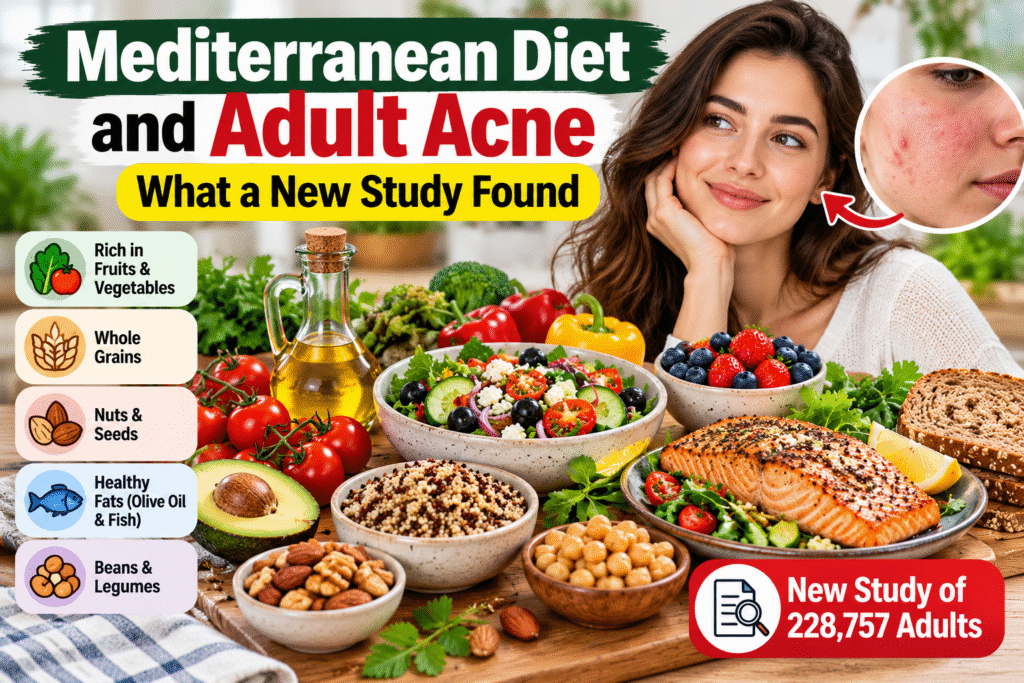
7 Mediterranean-Style Foods to Include More Often
These foods are commonly included when discussing Mediterranean diet and acne research.
If you want to make your eating pattern more Mediterranean-style, you can focus on a variety of minimally processed foods.
1. Leafy Green Vegetables
Spinach, kale, lettuce, and other leafy greens can be included in salads, sandwiches, soups, or cooked meals.
2. Tomatoes
Tomatoes are an easy addition to salads, sandwiches, soups, and cooked dishes.
3. Berries and Other Fruits
Blueberries, strawberries, oranges, apples, and other fruits can provide variety and important nutrients.
4. Whole Grains
Try foods such as:
- Oats
- Barley
- Brown rice
- Whole-wheat bread
- Whole-grain pasta
5. Beans and Lentils
Beans, chickpeas, and lentils can provide plant-based protein and fiber.
6. Nuts and Seeds
Almonds, walnuts, chia seeds, flaxseeds, and other nuts and seeds can be added to meals and snacks.
7. Fish
Fish can be included as part of a varied diet, particularly instead of some highly processed or heavily fried foods.
A Simple Mediterranean-Style Day
You don’t need complicated recipes to follow this eating pattern.
Breakfast
Oatmeal topped with berries, walnuts, and plain yogurt.
Lunch
A large vegetable salad with chickpeas, whole-grain bread, and olive oil-based dressing.
Snack
A piece of fruit with a small handful of unsalted nuts.
Dinner
Grilled fish with brown rice, cooked vegetables, and a simple salad.
This is only an example. Individual nutritional needs vary.
What About Dairy Products?
The study produced some interesting findings around dairy.
Yogurt was inversely associated with acne, while skimmed milk and milk-based desserts were positively associated with acne.
This does not mean everyone with acne should stop consuming dairy.
Different dairy products have different nutritional profiles, and the study was not designed to test whether removing a particular dairy food improves acne.
If you suspect a particular food is contributing to your symptoms, discussing the issue with a dermatologist or registered dietitian may be more useful than eliminating large food groups on your own.
Should You Avoid Sugar for Acne?
The new study did not prove that sugar causes adult acne.
However, reducing heavily processed foods and choosing more nutrient-dense foods can be part of an overall healthy eating pattern.
Instead of focusing on one ingredient, consider the quality of the entire diet.
For example, you could replace:
- Sugary desserts → fruit and plain yogurt
- Sweetened drinks → water
- Highly processed snacks → nuts or fruit
- Refined grains → whole-grain options
These changes can improve overall diet quality without requiring an extremely restrictive diet.
What the Study Does NOT Prove
This is one of the most important parts of the research.
The study does not prove that:
- Mediterranean diet cures acne.
- Vegetables directly eliminate acne.
- Yogurt treats acne.
- Milk causes acne in everyone.
- Pork causes acne.
- Avoiding carbohydrates prevents acne.
- A particular food can replace acne medication.
The researchers specifically noted limitations including the cross-sectional design, modest effect sizes, possible diagnostic misclassification, and the need for prospective and interventional studies.
More research is needed before the relationship between Mediterranean diet and acne can be understood with greater certainty.
Why Cross-Sectional Studies Have Limitations
In a cross-sectional study, researchers examine information from a particular period.
This makes it difficult to determine which came first.
For example, someone with acne might change their diet because they believe certain foods affect their skin.
If researchers then find an association between that diet and acne, they cannot automatically conclude that the diet caused the acne.
This is one reason longer-term prospective studies and randomized trials are valuable.
What Should You Do If You Have Adult Acne?
A healthy diet can be part of your overall lifestyle, but persistent acne may require professional evaluation.
Consider speaking with a dermatologist if acne:
- Is painful
- Is widespread
- Leaves scars
- Keeps returning
- Suddenly becomes severe
- Is affecting your quality of life
A dermatologist can determine whether you have acne or another skin condition that may look similar.
Dietary changes can complement healthy skincare, but they should not automatically replace evidence-based acne treatment.
8 Practical Eating Habits for Healthier Skin
Rather than following a highly restrictive acne diet, focus on sustainable habits.
1. Eat More Vegetables
Try adding vegetables to lunch and dinner every day.
2. Choose Whole Fruits
Use fruit as a snack or part of breakfast instead of relying heavily on sugary desserts.
3. Include Whole Grains
Replace some refined grains with oats, brown rice, barley, or whole-wheat products.
4. Eat More Beans and Lentils
These can be affordable sources of fiber and plant protein.
5. Choose Healthy Fats
Nuts, seeds, fish, and olive oil can fit into a balanced eating pattern.
6. Limit Highly Processed Foods
You don’t have to eliminate them. Simply make minimally processed foods the foundation of most meals.
7. Drink Water Regularly
Water can help you stay hydrated without adding sugar or excess calories.
8. Avoid Extreme Diets
Very restrictive diets can make it harder to obtain adequate nutrition and may not be necessary for managing acne.
Can a Mediterranean Diet Replace Acne Treatment?
No.
The current study does not establish the Mediterranean diet as an acne treatment.
The researchers found a statistical association between diet quality and adult acne, but they specifically called for prospective and interventional research to determine whether dietary changes actually influence acne development or improvement.
If you have persistent acne, evidence-based medical treatment may still be appropriate.
5 Simple Mediterranean-Style Meal Ideas
Breakfast
Oatmeal + berries + walnuts + plain yogurt
Lunch
Chickpea and vegetable salad + whole-grain bread
Snack
Apple + small handful of almonds
Dinner
Grilled fish + brown rice + cooked vegetables
Light Meal
Lentil soup + salad + whole-grain bread
These are general healthy eating examples rather than specific acne treatments.
Frequently Asked Questions
Can a Mediterranean diet help adult acne?
A new cross-sectional study found that greater adherence to a Mediterranean-style diet was associated with lower odds of current acne. However, the study cannot prove that the diet itself prevents or treats acne.
What foods are included in a Mediterranean diet?
The pattern emphasizes vegetables, fruits, whole grains, legumes, nuts, seeds, fish, olive oil, and other minimally processed foods.
Does yogurt cause acne?
This study found yogurt was inversely associated with acne, but that does not prove yogurt prevents acne or that it will have the same effect for everyone.
Does milk cause adult acne?
The study found an association between skimmed milk and acne, but it did not prove that skimmed milk causes acne. More research is needed.
Should I stop eating dairy if I have acne?
Not automatically. Dairy foods provide important nutrients, and this study does not establish that removing dairy improves acne.
Can fruits improve acne?
Fruits are nutritious foods that can be part of a healthy diet, but this study does not prove that eating fruit directly treats acne.
Is Mediterranean diet good for skin health?
A Mediterranean-style diet provides many nutrient-dense foods and was associated with lower odds of adult acne in this study. However, more research is needed to determine whether changing the diet directly improves acne.
What is the most important thing to remember?
Think about your overall eating pattern, rather than blaming one particular food. A varied diet rich in vegetables, fruits, whole grains, legumes, nuts, seeds, and other nutritious foods can support general health.
Key Takeaways
- A new study examined 228,757 UK Biobank participants.
- 1,603 participants had current acne and 5,709 reported a history of acne.
- Greater adherence to a Mediterranean-style diet was associated with lower odds of current acne.
- The association was also observed in exploratory analysis among women.
- Cooked vegetables and yogurt were inversely associated with acne in the study.
- Skimmed milk, milk-based desserts, and pork showed positive associations with acne.
- The study was cross-sectional, so it cannot establish causation.
- The findings do not mean that a Mediterranean diet cures acne.
- Researchers say prospective and intervention studies are needed to better understand the relationship.
Overall, the current evidence makes Mediterranean diet and acne an interesting topic for future research.
For more healthy skin and nutrition tips, explore our guide to 10 Foods for Healthy and Glowing Skin.
For the original research on diet quality and adult acne, read the study published in the Journal of the European Academy of Dermatology and Venereology.
Final Thoughts
The new research adds another piece to the growing discussion around Mediterranean diet and acne.
Among more than 228,000 UK Biobank participants, researchers found that greater adherence to a Mediterranean-style diet was associated with lower odds of current adult acne.
But the result should be viewed as an interesting association rather than proof of an acne treatment.
For now, a sensible approach is to focus on an overall nutritious eating pattern that includes plenty of vegetables, fruits, whole grains, legumes, nuts, seeds, and other minimally processed foods.
If acne is persistent, painful, severe, or leaving scars, professional dermatology care remains important.
Source
This article is based primarily on:
Li D, Xu Y, Zhang R, et al. “Associations between diet quality and adult acne: A cross-sectional study in the UK Biobank.” Journal of the European Academy of Dermatology and Venereology. Published September 24, 2026. DOI: 10.1111/jdv.70747.
King’s College London also reported the study’s findings on September 28, 2026.
Health Disclaimer
This article is for general educational and informational purposes only. It is not medical advice and does not diagnose, treat, or prevent acne or any other medical condition. If you have persistent, severe, painful, or scarring acne, consult a qualified dermatologist or healthcare professional.