
Published: October 3, 2026
Introduction
MIND diet and brain aging are receiving renewed attention after a long-running study found that people who followed the MIND dietary pattern more closely experienced slower changes in brain structure over time.
The research, published in the Journal of Neurology, Neurosurgery & Psychiatry in May 2026, included 1,647 middle-aged and older adults from the Framingham Heart Study Offspring cohort. Researchers followed participants for a median of 12.3 years, using repeated brain imaging to examine changes in brain structure. PubMed
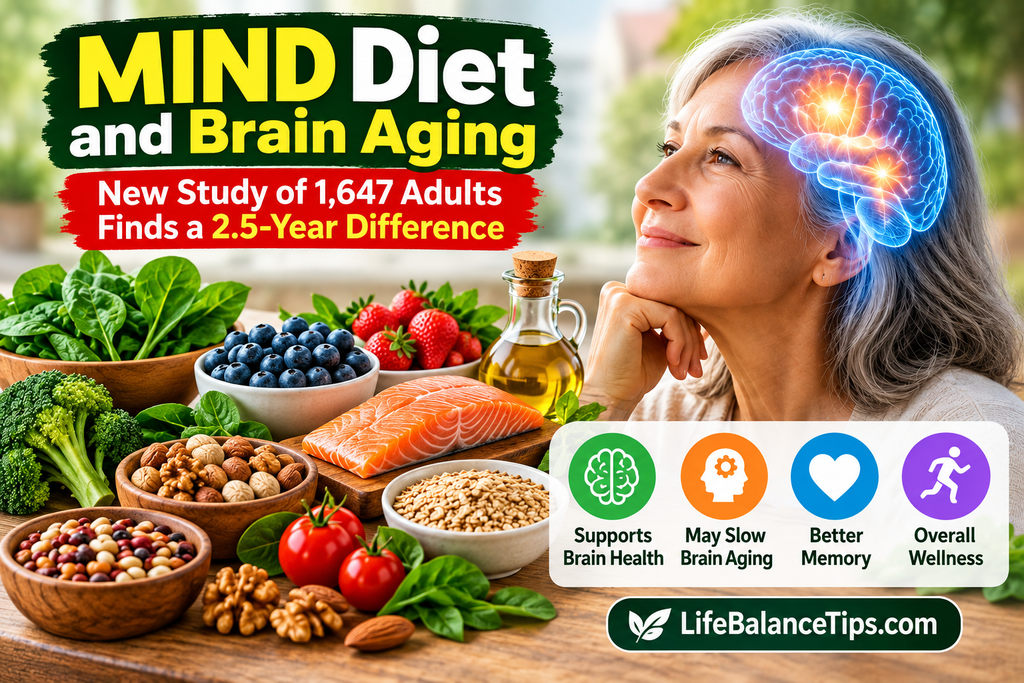
Researchers found that greater adherence to the MIND diet was associated with a slower decline in total gray matter volume. A three-point increase in the MIND diet score was associated with about 20.1% less age-related change in gray matter, which researchers described as equivalent to approximately 2.5 years of reduced brain aging over the follow-up period. PubMed
However, this was a prospective observational study. It does not prove that the MIND diet directly prevents brain aging or dementia.
So, what does the research actually tell us?
What Is the MIND Diet?
The MIND diet stands for Mediterranean-DASH Diet Intervention for Neurodegenerative Delay.
It combines principles from the Mediterranean diet and DASH diet, with particular emphasis on foods that have been studied in relation to cognitive and brain health.
The eating pattern emphasizes foods such as:
- Green leafy vegetables
- Other vegetables
- Berries
- Nuts
- Beans
- Whole grains
- Fish
- Poultry
- Olive oil
It also recommends limiting foods such as:
- Red meat
- Butter and margarine
- Cheese
- Pastries and sweets
- Fried fast foods
The MIND diet is therefore more than a list of individual “brain foods.” It is an overall dietary pattern.
That distinction is important when discussing the MIND diet and brain aging, because the study examined adherence to the complete eating pattern rather than the effect of one particular food. PubMed
What Did the New Study Examine?
The researchers studied 1,647 middle-aged and older adults from the Framingham Heart Study Offspring cohort.
Participants had dietary information collected using validated food-frequency questionnaires. Brain imaging was performed repeatedly between 1999 and 2019.
Participants had a median of approximately 12.3 years of follow-up, allowing researchers to examine how brain structures changed over time. PubMed
The researchers used MRI measurements to examine several structural markers, including:
- Total gray matter volume
- White matter volume
- Hippocampal volume
- Lateral ventricular volume
- Other brain-related imaging measures
The goal was to understand whether adherence to the MIND dietary pattern was associated with the pace of age-related structural brain changes.
This makes the research particularly interesting for the discussion surrounding the MIND diet and brain aging, because it looked at repeated brain scans rather than relying only on memory or cognitive tests.
What Did Researchers Find?
The main finding was an association between higher MIND diet adherence and slower decline in total gray matter volume.
Specifically, every three-point increase in the MIND diet score was associated with a 0.279 cm³ per year slower decline in total gray matter volume.
Researchers calculated that this represented approximately a 20.1% attenuation of age-related change, equivalent to about 2.5 years of reduced brain aging during the 12.3-year follow-up. PubMed
The researchers also found that higher MIND diet scores were associated with slower increases in lateral ventricular volume.
That association was equivalent to roughly one year of delayed brain aging for that particular structural measure. PubMed
These findings provide another reason researchers are interested in the MIND diet and brain aging, although they should be interpreted as associations rather than proof of cause and effect.
What Is Gray Matter?
Gray matter is an important component of the brain.
It contains many nerve-cell bodies and plays roles in functions such as:
- Memory
- Learning
- Decision-making
- Information processing
- Muscle control
Some loss of brain tissue naturally occurs with aging.
The study found that people with higher MIND diet scores experienced slower declines in total gray matter volume.
However, a change in gray matter volume on an MRI does not automatically mean that a person will develop dementia or another neurological disease.
Brain aging is complex and influenced by many factors.
What Are Brain Ventricles?
The ventricles are fluid-filled spaces within the brain.
As brain tissue decreases with age, ventricular spaces can become larger.
In the study, higher MIND diet adherence was associated with slower increases in lateral ventricular volume. PubMed
This is one reason the researchers looked at multiple brain structures rather than relying on a single measurement.
Still, these MRI findings should not be interpreted as a diagnosis or prediction for an individual.
Which Foods Are Included in the MIND Diet?
The MIND diet includes several food groups that are easy to incorporate into everyday meals.
1. Green Leafy Vegetables
Examples include:
- Spinach
- Kale
- Collard greens
- Lettuce
- Other leafy greens
These foods provide fiber, vitamins, minerals, and various plant compounds.
2. Other Vegetables
The MIND dietary pattern also encourages other vegetables.
Try:
- Broccoli
- Carrots
- Tomatoes
- Bell peppers
- Cauliflower
- Green beans
Using a variety of vegetables can make meals more nutritious and interesting.
3. Berries
Berries are a particularly distinctive part of the MIND diet.
Examples include:
- Blueberries
- Strawberries
- Raspberries
- Blackberries
In the study, higher berry intake was associated with some favorable brain structural measures, although these food-specific findings also remain observational. ScienceDaily
4. Nuts
Nuts can provide:
- Unsaturated fats
- Protein
- Fiber
- Vitamin E
- Other nutrients
Examples include:
- Walnuts
- Almonds
- Pistachios
- Peanuts
Choose unsalted varieties when possible.
5. Beans and Legumes
Beans and legumes can provide plant protein and fiber.
Examples include:
- Black beans
- Kidney beans
- Chickpeas
- Lentils
- Pinto beans
They can be added to soups, salads, curries, and grain-based meals.
6. Whole Grains
Examples include:
- Oats
- Brown rice
- Barley
- Whole-grain bread
- Whole-grain pasta
The MIND pattern includes whole grains as one of its recommended food groups.
Interestingly, the new study reported some unexpected associations for whole-grain intake with certain brain structural measures. These findings should not be interpreted as proof that whole grains are harmful, especially because the overall dietary pattern and observational design are important. ScienceDaily
7. Fish
Fish is another important component.
Examples include:
- Salmon
- Sardines
- Trout
- Tuna
Fatty fish can provide omega-3 fatty acids, while fish in general can provide protein and other nutrients.
8. Poultry
Chicken and turkey are commonly included in the MIND dietary pattern.
The study also found that higher poultry intake was associated with some favorable structural brain changes, although again, these results cannot establish that poultry itself caused those changes. ScienceDaily
9. Olive Oil
Olive oil is a major source of unsaturated fat and is commonly used in Mediterranean-style eating patterns.
It can be used for:
- Salad dressing
- Cooking
- Roasted vegetables
- Grain dishes
Foods the MIND Diet Recommends Limiting
The MIND diet also focuses on limiting certain foods.
Butter and Margarine
The pattern recommends limiting butter and margarine.
Cheese
Cheese is limited compared with some other dietary patterns.
Red Meat
The MIND diet encourages limiting red meat.
Pastries and Sweets
Foods such as cakes, cookies, pastries, and other sweets are limited.
Fried Fast Foods
Fried fast foods are another category that the MIND diet recommends limiting.
The purpose is not necessarily to make every food “forbidden.” Instead, the overall dietary pattern emphasizes nutrient-rich foods more frequently.
MIND Diet and Brain Aging: Why Might Diet Matter?
Researchers are interested in several possible pathways connecting diet with brain health.
A nutritious dietary pattern can provide:
- Fiber
- Unsaturated fats
- Vitamins
- Minerals
- Plant compounds
- Protein
- Antioxidants
Diet can also influence cardiovascular and metabolic health, which are relevant to brain health.
For example, high blood pressure and cardiovascular disease are associated with poorer brain health.
However, the exact biological mechanisms behind the associations observed in this study are not fully established.
The study therefore adds evidence to the broader research discussion about the MIND diet and brain aging, but it does not provide a complete explanation of how diet affects the aging brain.
Does the MIND Diet Prevent Alzheimer’s Disease?
This study did not prove that the MIND diet prevents Alzheimer’s disease.
It examined structural changes in the brain rather than proving prevention of a specific neurological disease.
Previous research has investigated the MIND diet and cognitive outcomes, with results that are not completely consistent across study designs.
A 2025 systematic review found that many observational studies showed favorable associations between MIND adherence and cognitive outcomes, but randomized controlled trials have produced mixed findings. PubMed
Another 2026 analysis of the original MIND trial found that participants who substantially improved their MIND diet scores had better changes in global cognitive scores, but this was a post-hoc analysis and should also be interpreted carefully. PubMed
Therefore, more research is still needed.
What About the 2.5-Year Brain-Aging Finding?
The phrase “2.5 years slower brain aging” can sound stronger than what the study actually demonstrated.
The researchers did not observe that participants literally became 2.5 years younger.
Instead, they calculated that the difference in the rate of gray matter change associated with a three-point increase in MIND score was statistically equivalent to about 2.5 years of age-related change during the follow-up period. PubMed
That distinction is important.
It is more accurate to say:
Higher MIND diet adherence was associated with slower structural brain changes equivalent to about 2.5 years of reduced brain aging in this study.
It is not accurate to say:
The MIND diet reverses brain aging by 2.5 years.
A Simple One-Day MIND-Style Meal Plan
Here is an example of how someone might incorporate MIND-style foods into a normal day.
Breakfast
- Oatmeal
- Blueberries
- Walnuts
- Plain yogurt
Lunch
- Lentil or chickpea salad
- Leafy greens
- Tomatoes
- Olive-oil dressing
- Whole-grain bread
Snack
- A small portion of unsalted nuts
- Fresh berries
Dinner
- Grilled salmon
- Brown rice
- Broccoli
- Leafy green salad
Beverage
- Water
- Unsweetened tea
- Plain coffee
This is an example of a balanced eating pattern, not a prescribed medical diet.
7 Practical Ways to Follow the MIND Diet
1. Add Leafy Greens Regularly
Try adding spinach or another leafy green to lunch or dinner.
2. Keep Berries Available
Fresh or frozen berries can be added to oatmeal or yogurt.
3. Snack on Nuts
Choose a small portion of unsalted nuts instead of highly processed snacks.
4. Eat Beans More Often
Replace some meat-based meals with beans or lentils.
5. Choose Whole Grains
Use oats, brown rice, barley, or whole-grain bread more often.
6. Include Fish
If you eat fish, include it as part of a varied diet.
7. Reduce Sweets and Fried Fast Foods
These foods can be occasional choices rather than daily staples.
These simple habits can make MIND diet and brain aging research more practical for everyday readers without turning the diet into a rigid set of rules.
What Makes This Study Different From a Typical Food Study?
Many nutrition articles focus on individual foods.
This study is different because researchers calculated a dietary score representing adherence to an overall dietary pattern.
They then compared that score with repeated brain imaging measurements.
That approach provides a more complete picture of dietary behavior.
However, it also creates challenges.
People who follow healthier diets may also:
- Exercise more
- Smoke less
- Have different education levels
- Have different healthcare access
- Have different body weights
- Have different medical conditions
Researchers adjusted for several factors, but observational studies cannot remove every possible confounding factor.
Important Limitations of the Study
Understanding limitations is essential when reading health research.
1. It Was Observational
The researchers observed participants rather than randomly assigning them to different diets.
Therefore, the study cannot establish causation.
2. Diet Was Self-Reported
Food-frequency questionnaires depend on participants accurately reporting their food intake.
This can introduce measurement and recall errors.
3. Participants Were Not Fully Representative of Everyone
The Framingham cohort has particular demographic characteristics, so the findings may not apply equally to every population.
4. Brain Structure Is Not the Same as Cognitive Function
Changes in MRI measurements do not automatically translate into changes in memory or thinking ability.
5. More Research Is Needed
Randomized trials and research involving more diverse populations can help clarify whether changing diet directly influences long-term brain aging.
These limitations are important when interpreting claims about the MIND diet and brain aging.
MIND Diet vs. Mediterranean Diet
The MIND diet combines elements of the Mediterranean and DASH approaches.
| Feature | MIND Diet | Mediterranean Diet |
| Vegetables | Strong emphasis | Strong emphasis |
| Leafy greens | Specifically emphasized | Important |
| Berries | Specifically emphasized | Fruit generally emphasized |
| Whole grains | Emphasized | Emphasized |
| Nuts | Emphasized | Emphasized |
| Fish | Emphasized | Emphasized |
| Olive oil | Emphasized | Major component |
| Red meat | Limited | Generally limited |
| Sweets | Limited | Generally limited |
| Brain health focus | Specific focus | Broader cardiovascular and metabolic focus |
Both dietary patterns emphasize minimally processed, nutrient-rich foods.
Neither should be viewed as a guaranteed treatment for neurological disease.
Does Everyone Need to Follow the MIND Diet?
No.
The study does not establish that every person needs to follow a strict MIND diet.
Many healthy dietary patterns share similar principles:
- Eat more vegetables
- Choose whole foods
- Include healthy fats
- Eat adequate protein
- Include fiber-rich foods
- Limit excess added sugar
- Limit highly processed foods
- Maintain an appropriate calorie balance
Someone can therefore improve diet quality without following the MIND scoring system perfectly.
Frequently Asked Questions
What is the MIND diet?
The MIND diet is a dietary pattern combining elements of the Mediterranean and DASH diets, with specific emphasis on foods associated with brain and cognitive health.
What did the new study find?
The study found that higher MIND diet adherence was associated with slower declines in gray matter volume and slower increases in ventricular volume over a median 12.3-year follow-up. PubMed
Did the study prove the MIND diet slows brain aging?
No. The study was observational, so it found associations rather than proving cause and effect.
How many people were studied?
The research included 1,647 middle-aged and older adults from the Framingham Heart Study Offspring cohort. PubMed
How long were participants followed?
The median follow-up was 12.3 years. PubMed
What does the 2.5-year finding mean?
Researchers calculated that the difference in gray matter decline associated with higher MIND diet adherence was equivalent to about 2.5 years of reduced age-related brain change during follow-up. It does not mean the brain literally became 2.5 years younger. PubMed
Which foods are emphasized by the MIND diet?
The pattern emphasizes leafy greens, other vegetables, berries, nuts, beans, whole grains, fish, poultry, and olive oil.
Which foods are limited?
Butter and margarine, cheese, red meat, pastries and sweets, and fried fast foods are among the foods the MIND diet recommends limiting.
Can the MIND diet prevent dementia?
Current research does not establish that the MIND diet definitely prevents dementia. Evidence from observational studies is encouraging in some areas, but randomized research has produced mixed findings. PubMed
Is the MIND diet suitable for everyone?
Not necessarily. Individual dietary needs vary, especially for people with medical conditions, food allergies, kidney disease, diabetes, or other health concerns.
Key Takeaways
The new research provides an interesting look at the relationship between diet and long-term changes in brain structure.
The main points are:
- The study included 1,647 adults.
- Participants were middle-aged and older adults.
- Median follow-up was 12.3 years.
- Researchers used repeated MRI scans.
- Higher MIND diet adherence was associated with slower gray matter loss.
- A three-point increase in MIND score was associated with approximately 20.1% less age-related gray matter change.
- Researchers described the difference as equivalent to approximately 2.5 years of reduced brain aging during follow-up.
- Higher MIND adherence was also associated with slower ventricular enlargement.
- The research was observational.
- The findings do not prove that the diet directly prevents brain aging or dementia.
Overall, MIND diet and brain aging research is promising but still developing.
For more nutrition and brain-health tips, explore our guide to 15 Best Foods for Brain Health and Better Memory.
For the original research, see the study published in the Journal of Neurology, Neurosurgery & Psychiatry.
Final Thoughts
The latest evidence adds another interesting piece to the growing research on the MIND diet and brain aging.
In a study of 1,647 middle-aged and older adults, greater adherence to the MIND dietary pattern was associated with slower changes in gray matter and other brain structures over approximately 12 years. Researchers estimated that the difference in gray matter change associated with a three-point higher MIND score was equivalent to about 2.5 years of reduced brain aging. PubMed
But the finding should not be exaggerated.
The study does not prove that the MIND diet directly slows aging, prevents Alzheimer’s disease, or guarantees better memory. It was an observational study, and factors other than diet may have contributed to the observed associations.
Still, the MIND pattern includes many generally nutritious foods—vegetables, berries, nuts, beans, whole grains, fish, poultry, and olive oil—while encouraging people to limit sweets, fried fast foods, and other less nutritious choices.
For someone looking to improve their overall diet, these principles can be practical without requiring a perfect or restrictive eating plan.
More randomized and long-term research will help determine how much changing the diet itself can influence brain structure and cognitive health.
Source
Chen H, Hailili G, Tong L-S, et al. Adherence to the MIND diet and longitudinal brain structural changes over a decade: evidence from the Framingham Heart Study Offspring cohort. Journal of Neurology, Neurosurgery & Psychiatry. 2026;97(6):505–512. DOI: 10.1136/jnnp-2025-336957. PubMed
Health Disclaimer
This article is for general educational and informational purposes only. It is not medical advice and does not diagnose, treat, or prevent Alzheimer’s disease, dementia, or any other medical condition. If you have a medical condition or specific concerns about your diet, memory, or brain health, speak with a qualified healthcare professional or registered dietitian.