
Focus Keyword: food processing and metabolism
Secondary Keywords:
food processing effects on metabolism, ultra-processed food metabolism, processed food and insulin, food processing and brain health, same calories different effects, minimally processed foods, ultra-processed foods and metabolism
Introduction
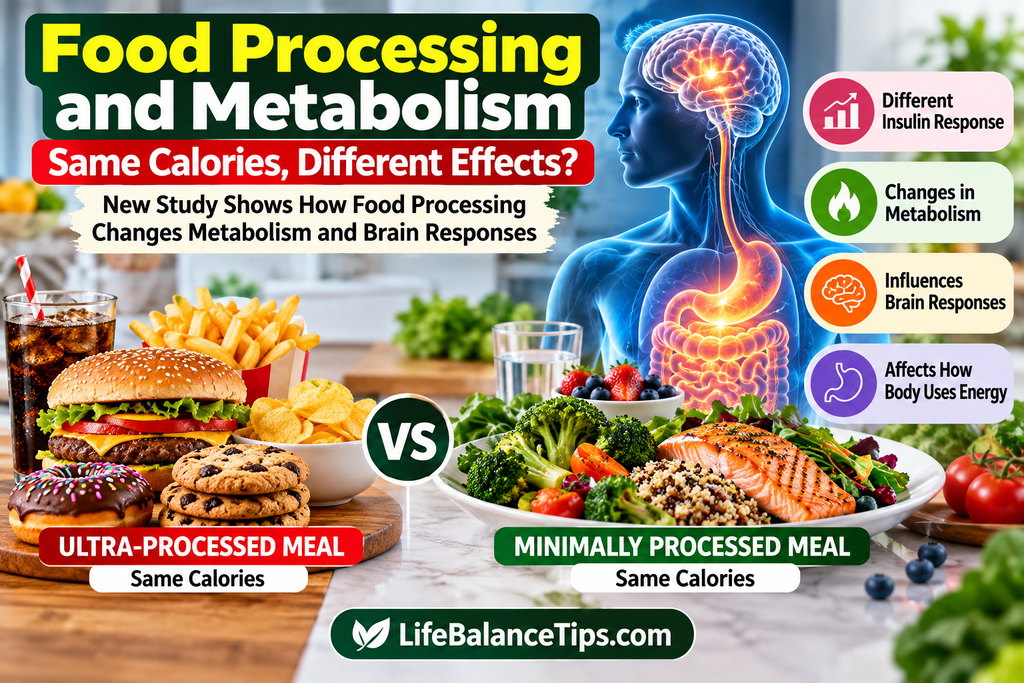
Food processing and metabolism are gaining new attention after a randomized study found that meals with very similar nutritional profiles could produce different metabolic and brain responses depending on how the foods were processed.
The study, published October 5, 2026, in Nature Metabolism, compared ultra-processed (UPF) and non-ultra-processed meals in healthy-weight adults. Researchers carefully matched the meals for calories, macronutrients, available carbohydrates, glycemic index, glycemic load, fiber, sodium, water, and other nutritional characteristics. Nature
Despite these similarities, the researchers observed differences in insulin responses, metabolic rate, carbohydrate oxidation, and some neural responses to food cues.
The findings do not mean that all processed foods are unhealthy or that calories do not matter. Instead, the study suggests that the physical and industrial processing of food may influence what happens in the body after eating in ways that are not completely explained by calories and macronutrients alone.
This article explains what the researchers found, what it could mean, and why more research is still needed.
What Is the New Study About?
The research was designed to investigate whether food processing itself could influence the body’s response to food when the nutritional composition is closely matched.
The study involved 57 healthy-weight adults. Of these:
- 32 completed both metabolic testing sessions.
- 52 completed the functional MRI session.
- The average participant age was about 26 years.
- Participants had an average BMI of approximately 22.8.
The researchers used a randomized crossover design for the metabolic portion. This meant participants consumed both types of meals on separate occasions, allowing researchers to compare responses within the same individuals. Nature
This is important because people naturally differ in metabolism, appetite, body composition, and dietary habits.
The crossover design helps reduce some of that individual variation.
How Were the Meals Matched?
One of the most interesting parts of the research was how carefully the meals were matched.
The UPF and non-UPF meals were designed to be very similar in:
- Calories
- Protein
- Carbohydrates
- Fat
- Available carbohydrates
- Glycemic index
- Glycemic load
- Dietary fiber
- Sodium
- Water
- Meal weight
- Energy density
The researchers reported less than 1.6% deviation between the meals for these matching characteristics. Nature
Each test meal contained approximately 300 calories, and participants were asked to finish it within 10 minutes.
The metabolic testing then continued for approximately three hours after the meal, with blood samples and measurements of energy expenditure and fuel use.
This controlled design makes the findings particularly interesting when discussing food processing and metabolism.
What Did Researchers Find?
The researchers found several differences between the two meal conditions.
The UPF meal produced a greater insulin response compared with the non-UPF meal.
The study also found differences in metabolic rate and the way the body appeared to use carbohydrates and fat after eating.
Importantly, blood glucose area-under-the-curve measurements did not differ significantly between the two conditions, although there were differences at particular time points. Nature
This means the story was not simply:
“Processed food causes higher blood sugar.”
Instead, the researchers observed a more complicated pattern involving insulin, energy expenditure, and fuel oxidation.
That complexity is one reason the findings are scientifically interesting.
Insulin Response Was Higher After the UPF Meal
One of the clearest findings involved insulin.
The researchers reported a significantly greater insulin response after the UPF meal.
Insulin is a hormone that helps the body regulate blood glucose and plays an important role in directing nutrients into tissues after eating.
A single meal with a different insulin response does not mean that someone will develop diabetes.
However, researchers are interested in whether repeated differences in post-meal metabolic responses could contribute to long-term metabolic health.
The current study cannot answer that long-term question because it examined acute responses to meals.
Still, the result provides experimental evidence relevant to food processing and metabolism.
What Happened to Carbohydrate Oxidation?
Another interesting result involved carbohydrate oxidation.
After the non-UPF meal, carbohydrate oxidation showed a stronger post-meal response compared with the UPF meal.
The researchers described this as an attenuated shift toward carbohydrate oxidation after the UPF meal.
Fat oxidation showed the opposite pattern in the study. Nature
In simple terms, the body appeared to handle the energy from the two meals differently even though the meals were nutritionally matched.
This does not mean one fuel source is automatically “good” and the other is “bad.”
The body normally switches between carbohydrates and fats as energy sources.
The important point is that the processing level appeared to influence the timing and pattern of this metabolic response.
Did the UPF Meal Increase Metabolic Rate?
Yes, researchers found a difference in metabolic rate after the two meals.
The area under the metabolic-rate curve was greater after the UPF meal.
However, this should not be interpreted as meaning ultra-processed food is beneficial for weight loss.
The researchers were studying short-term metabolic responses, not long-term changes in body weight.
A temporary difference in energy expenditure following one meal cannot tell us whether a dietary pattern causes weight loss or weight gain over months or years.
That distinction is especially important when interpreting research on food processing and metabolism.
What About Blood Glucose?
Interestingly, the researchers did not find a significant difference in total blood glucose area under the curve between the two meal conditions.
There was, however, a time-by-diet interaction, with blood glucose higher in the non-UPF condition at around 20 minutes after the meal. Nature
This finding highlights why looking only at blood glucose may not provide a complete picture of what happens after eating.
Insulin, energy expenditure, carbohydrate oxidation, fat oxidation, and other metabolic signals can respond differently.
Nutrition research therefore often needs to examine several physiological measurements rather than relying on one number.
The Study Also Looked at the Brain
The research was not limited to metabolism.
Researchers also used functional MRI to examine brain responses to pictures of foods.
Participants viewed images of both ultra-processed and non-ultra-processed foods and completed tasks designed to measure food valuation.
The researchers found associations between metabolic responses and neural responses in areas including the striatum, a brain region involved in reward and motivation. Nature
This is particularly interesting because eating behavior is influenced by more than hunger.
Food cues, learned preferences, reward, taste, smell, and metabolic signals can all interact.
What Is the Gut-to-Brain Connection?
After food is eaten, information about nutrients does not remain limited to the digestive system.
Signals from the digestive tract and metabolic system can communicate with the brain.
Researchers refer to this broad communication as gut-to-brain signaling.
The new study explored whether differences in post-meal metabolism were associated with differences in neural responses to food cues.
The findings do not prove that UPFs “change the brain” in a harmful way after one meal.
Instead, they provide experimental evidence that food processing can be associated with differences in metabolic signals and neural responses. Nature
Why Could Food Processing Matter?
Food processing can change the physical structure of foods.
Cooking, grinding, milling, homogenizing, and other processes can affect:
- Texture
- Digestion
- Nutrient availability
- Eating speed
- Energy density
- Satiety
- The way nutrients become available during digestion
Ultra-processing can involve additional industrial ingredients and multiple manufacturing steps.
The new study supports the idea that these characteristics may influence physiological responses beyond the basic calorie and macronutrient numbers.
This is an important area for ongoing research into food processing and metabolism.
Does This Mean All Processed Food Is Bad?
No.
This is one of the most important points to understand.
Food processing exists on a spectrum.
Some forms of processing are simple and useful.
For example:
- Washing vegetables
- Freezing fruit
- Pasteurizing milk
- Cooking beans
- Canning vegetables
- Grinding grains
- Fermenting foods
These processes can improve safety, convenience, shelf life, or digestibility.
Therefore, it would be inaccurate to label every processed food as unhealthy.
The study specifically compared ultra-processed and non-ultra-processed meals, not every processed food available in grocery stores.
What Are Ultra-Processed Foods?
The study used the NOVA classification system to distinguish ultra-processed foods from non-ultra-processed foods. Nature
Ultra-processed foods generally refer to industrially formulated products that may contain multiple ingredients and additives not commonly used in home cooking.
Examples can include some:
- Packaged snack foods
- Sweetened beverages
- Ready-to-eat desserts
- Processed breakfast products
- Packaged convenience meals
- Certain processed meat products
However, classification can sometimes be complicated.
A food should not automatically be considered unhealthy simply because it comes in a package.
The overall nutritional profile, portion size, dietary pattern, and individual circumstances also matter.
Why Calories Still Matter
The study does not overturn basic energy balance principles.
Calories remain an important component of body weight regulation.
What this study suggests is that calories may not explain every physiological response to a meal.
Two foods can have similar calories but differ in:
- Texture
- Digestion rate
- Nutrient availability
- Eating speed
- Insulin response
- Satiety
- Metabolic response
Therefore, the phrase “same calories” should not be interpreted as “identical biological effects.”
This is one of the key lessons from the new research on food processing and metabolism.
Could This Explain Why Some People Overeat Ultra-Processed Foods?
The study provides a possible mechanism, but it does not prove this explanation.
Researchers observed relationships between metabolic differences and neural responses to food cues.
The authors suggest that altered post-ingestive responses could potentially contribute to food valuation and overeating. Nature
However, the study did not follow participants for months to determine whether these acute responses caused overeating or weight gain.
Many other factors affect food intake, including:
- Hunger
- Stress
- Sleep
- Food availability
- Portion size
- Eating habits
- Social environment
- Food preferences
- Cost and convenience
So it would be premature to say that the study proves why people overeat ultra-processed foods.
What Does This Mean for Everyday Eating?
The findings do not mean you need to eliminate packaged foods.
Instead, they add another reason to focus on overall diet quality.
A practical approach is to build most meals around foods such as:
Vegetables
Try leafy greens, broccoli, carrots, tomatoes, peppers, and other vegetables.
Fruits
Choose whole fruits more often than sugary fruit-flavored products.
Whole Grains
Oats, brown rice, barley, and whole-grain bread can be useful options.
Beans and Lentils
These provide fiber, plant protein, and other nutrients.
Nuts and Seeds
Choose unsalted varieties and reasonable portions.
Fish and Other Protein Foods
Fish, eggs, poultry, beans, lentils, yogurt, and other nutritious protein sources can fit into a balanced diet.
Water and Unsweetened Drinks
Water and unsweetened beverages can help reduce reliance on sugar-sweetened drinks.
These principles are consistent with the broader idea of emphasizing nutritious foods rather than trying to follow a perfect “processed food versus unprocessed food” rule.
7 Simple Ways to Reduce Ultra-Processed Foods
1. Replace Sugary Drinks
Choose water, sparkling water, or unsweetened beverages more often.
2. Choose Whole Fruit
Instead of relying mainly on sweet snacks, keep fruit available for quick meals and snacks.
3. Add More Vegetables
Include vegetables at lunch and dinner.
4. Choose Whole Grains
Try oats, brown rice, barley, or whole-grain bread.
5. Prepare More Meals at Home
Home cooking makes it easier to control ingredients and portions.
6. Check the Nutrition Facts Label
Look at calories, added sugars, sodium, saturated fat, fiber, and protein rather than relying only on front-of-package claims.
7. Don’t Aim for Perfection
An occasional packaged snack does not automatically make an otherwise nutritious diet unhealthy.
Consistency matters more than perfection.
What Makes This Study Strong?
Several aspects make the research particularly valuable.
Randomized Crossover Design
Participants completed both meal conditions, allowing within-person comparisons.
Nutritionally Matched Meals
Researchers carefully matched many important nutritional variables.
Controlled Metabolic Testing
Participants were monitored using whole-room indirect calorimetry.
Blood Measurements
Researchers collected blood samples to measure metabolic responses, including insulin and glucose.
Brain Imaging
The researchers also examined neural responses using fMRI.
Together, these methods provide a more detailed picture than a simple food questionnaire study.
Important Limitations
Despite its strengths, the research has important limitations.
Small Sample Size
The full study included 57 participants, while only 32 completed both metabolic sessions.
That is relatively small compared with large population studies.
Young, Healthy Participants
Participants were healthy-weight adults with an average age of about 26 years.
The findings may not apply directly to:
- Older adults
- Children
- People with obesity
- People with diabetes
- People with cardiovascular disease
- People with other metabolic conditions
Short-Term Experiment
The metabolic experiment examined responses for only a few hours after eating.
It cannot tell us what happens after years of consuming different dietary patterns.
Specialized Test Meals
The researchers created carefully matched meals for scientific testing.
Real-world diets are much more complicated.
More Research Is Needed
The study provides experimental evidence, but larger and longer studies are needed to determine how processing affects long-term health.
These limitations are essential when interpreting claims about food processing and metabolism.
What Should You Take Away From the Study?
The biggest lesson is not that calories are irrelevant.
Instead, the study suggests that how food is processed may influence the body’s response to that food even when basic nutritional characteristics are closely matched.
Researchers observed differences in:
- Insulin response
- Metabolic rate
- Carbohydrate oxidation
- Fat oxidation
- Brain responses to food cues
The findings provide experimental evidence that processing level may influence physiology through mechanisms that extend beyond calories and macronutrients. Nature
But the research does not prove that ultra-processed foods directly cause obesity, diabetes, or brain disease.
Those long-term questions require additional research.
Frequently Asked Questions
Does this study prove that ultra-processed foods are unhealthy?
No. It provides experimental evidence of different short-term metabolic and neural responses, but it does not establish long-term disease causation.
Were the calories in the meals the same?
Yes. The test meals were approximately 300 calories and were carefully matched for multiple nutritional characteristics. Nature
Did ultra-processed food increase blood sugar?
The overall blood glucose area under the curve did not significantly differ between the meals, although researchers observed differences at specific time points. Nature
Did the UPF meal increase insulin?
Yes. The researchers reported a significantly greater insulin response after the ultra-processed meal. Nature
Did the study prove that UPFs cause overeating?
No. The findings provide possible clues about metabolic and neural mechanisms, but they do not prove that UPFs cause overeating.
Should I stop eating all processed foods?
No. Processing exists on a spectrum, and many processed foods can be nutritious and useful. Focus on overall dietary quality.
Are frozen vegetables processed foods?
Freezing is a form of processing, but that does not automatically make frozen vegetables unhealthy. Processing should be considered in context.
What is the simplest way to eat less ultra-processed food?
Start by eating more vegetables, fruits, whole grains, beans, nuts, and other minimally processed foods while reducing frequent consumption of highly processed snacks and sugary drinks.
For more practical healthy eating tips, explore our guide to 10 Healthy Food Swaps for a Healthier Everyday Diet.
Read the original study in Nature Metabolism
Final Thoughts
The new Nature Metabolism study provides an interesting new perspective on food processing and metabolism.
Researchers compared ultra-processed and non-ultra-processed meals that were closely matched for calories, macronutrients, fiber, sodium, glycemic characteristics, and other nutritional factors. Yet the meals produced different post-meal metabolic responses, including differences in insulin, metabolic rate, carbohydrate oxidation, and fat oxidation. Nature
The researchers also found relationships between some metabolic responses and neural responses to food cues.
These findings do not mean calories no longer matter, nor do they prove that every ultra-processed food is harmful.
Instead, they suggest that the physical and industrial processing of food may be one factor influencing how the body responds after eating.
For everyday health, the practical message is simple: build your diet primarily around vegetables, fruits, whole grains, beans, nuts, seeds, healthy protein sources, and other nutrient-rich foods, while keeping highly processed foods as a smaller part of the overall diet.
More research involving larger and more diverse populations, longer follow-up periods, and real-world eating patterns will be needed to understand the long-term significance of these findings.
The new evidence makes food processing and metabolism an important area for continued nutrition research.
Source
Hutelin Z, Ahrens M, Baugh ME, et al. Metabolic and neural responses to ultra-processed foods: a randomized, controlled, crossover study. Nature Metabolism. Published October 5, 2026. DOI: 10.1038/s42255-026-01619-4. Nature
Read the original Nature Metabolism study.
Health Disclaimer
This article is for general educational and informational purposes only. It is not medical advice and does not diagnose, treat, or prevent any disease. Individual nutritional needs vary. If you have diabetes, heart disease, digestive problems, or another medical condition, speak with a qualified healthcare professional or registered dietitian before making major dietary changes.