
Published: September 26, 2026
Walk through almost any supermarket aisle, and food packages are covered with claims designed to catch your attention.
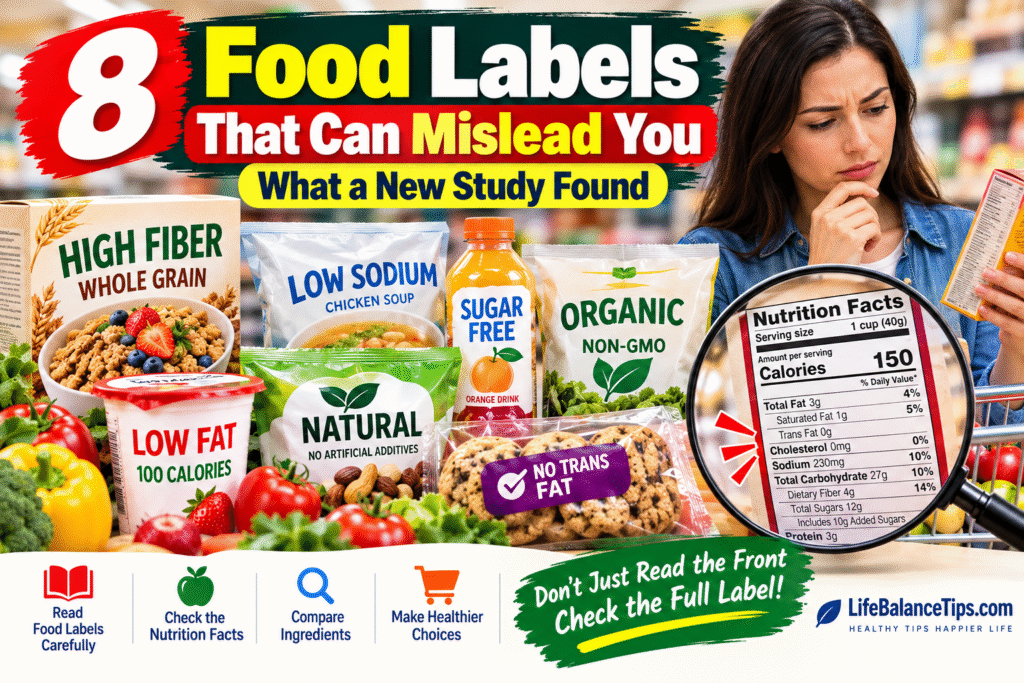
You may see phrases such as “Low Sodium,” “Sugar Free,” “High Fiber,” “Organic,” “Whole Grain,” “No Additives,” or “Natural.”
These statements can provide useful information about a particular characteristic of a product. But a new study suggests that a health-related claim on the front of a package does not always tell the complete story about the product’s overall nutritional quality.
The analysis, published in Nature Food on September 24, 2026, examined 145,609 newly launched food and beverage products in the United States from 2015 through 2024. Researchers compared products with and without different types of on-package claims and evaluated their overall nutritional profiles.
The researchers found that on-package claims were imperfect signals of overall nutritional quality. In some cases, improving one nutritional characteristic appeared to be accompanied by less favorable levels of another nutrient.
This does not mean that food labels are false or that every product carrying a health-related claim is unhealthy. Instead, the study highlights why shoppers may benefit from looking beyond the front of the package and checking the Nutrition Facts panel and ingredient list.
Understanding food labels can help consumers make more informed choices when buying packaged foods.
What Did the New Study Examine?
The researchers analyzed information from the Mintel Global New Products Database, which tracks newly launched packaged food and beverage products.
The final dataset contained 145,609 products, covering beverages and 10 categories of processed consumer packaged goods. The products were launched in the United States between 2015 and 2024.
Researchers grouped on-package claims into four broad categories:
- Minus claims: reduced or absent amounts of nutrients such as sodium, sugar, calories, saturated fat, or trans fat
- Plus claims: added or higher amounts of potentially beneficial nutrients such as fiber, protein, vitamins, or minerals
- Natural claims: claims such as organic, GMO-free, whole grain, or no artificial additives
- Functional claims: claims related to physiological or health benefits, such as antioxidant or cardiovascular-health claims
The researchers then evaluated products using the UK Nutrient Profiling Model, which considers several nutrients together instead of focusing on just one nutrient.
The model considers components to limit, such as sugar, sodium, saturated fat, and calories, while also rewarding components such as fiber, protein, and fruit and vegetable content.
Why Food Labels Can Be Confusing
A food label may highlight one positive feature while leaving other nutritional characteristics less visible.
For example, a product might advertise that it contains less sodium.
That statement can be accurate.
But the product may still contain substantial amounts of added sugar, saturated fat, calories, or other nutrients that consumers may also want to consider.
The study found evidence of these kinds of trade-offs and selective signaling in some product categories.
This is why looking at one claim alone may not provide a complete picture.
Reading food labels carefully is especially useful when comparing similar packaged products.
1. “Low Sodium” Does Not Tell You Everything
A low-sodium claim focuses specifically on sodium.
For someone trying to reduce sodium intake, this information can be useful.
However, the new analysis found that some beverage products carrying low, no, or reduced sodium claims had less favorable overall nutritional profiles in comparison with products without those claims.
The researchers identified higher total sugar as one factor contributing to some of these discrepancies.
This doesn’t mean low-sodium products are automatically unhealthy.
It simply means that sodium should not be the only number you check.
What to do
When you see a low-sodium claim, also check:
- Added sugars
- Calories
- Saturated fat
- Protein
- Fiber
- Serving size
Looking at several nutrients together gives you more information.
2. “Sugar Free” Is Not the Same as “Healthy”
A sugar-free claim can be useful if you are specifically trying to limit sugar.
But sugar is only one part of a product’s nutritional profile.
The study found that some beverage products carrying sugar-free claims did not necessarily have the most favorable overall nutritional profiles.
Therefore, don’t assume that “sugar free” automatically means:
- Low calorie
- High in nutrients
- High in fiber
- Low in sodium
- Low in saturated fat
A better approach
Check the complete Nutrition Facts label.
Also look at the ingredient list to understand what the product contains.
3. “Low Saturated Fat” Needs a Closer Look
Saturated fat is an important nutrient to consider as part of an overall healthy eating pattern.
However, reducing saturated fat in a product does not necessarily tell you what replaced it.
The researchers found discrepancies involving low, no, or reduced saturated-fat claims in some beverage categories, with differences involving other nutritional components such as total sugar.
The practical lesson is simple:
Don’t judge the entire product based on one nutrient claim.
Compare the full Nutrition Facts panel instead.
4. “No Trans Fat” Does Not Mean the Product Is Automatically Healthy
Trans fat has received considerable attention because of its relationship with cardiovascular health.
But a product making a no trans-fat claim can still contain other nutrients that you may want to limit.
The study found that food products carrying low, no, or reduced trans-fat claims were an important example of a discrepancy between an individual claim and overall nutritional quality. Researchers observed associations with higher saturated fat in some categories.
Again, this doesn’t mean a no-trans-fat claim is useless.
It means the claim provides one piece of information rather than the complete nutritional picture.
5. “High Fiber” Is Helpful Information—but Check the Whole Label
Fiber is an important part of a balanced diet.
A product labeled high fiber may provide more fiber than a comparable product.
However, the presence of fiber doesn’t automatically tell you how much sugar, sodium, saturated fat, or calories the product contains.
The new research included high or added fiber claims among the “Plus” claims it analyzed.
When buying a high-fiber product, check:
- Fiber per serving
- Added sugars
- Total calories
- Sodium
- Protein
- Ingredient list
A higher-fiber product can be a useful choice, but the entire nutritional profile still matters.
6. “Natural” Can Create a Health Halo
The word “natural” is particularly interesting.
Consumers may interpret “natural” as meaning a food is healthier, even though the term does not necessarily describe the product’s overall levels of sugar, sodium, saturated fat, or calories.
The researchers discussed this phenomenon as a possible “health halo” effect, where a positive impression from one feature influences how consumers perceive the product as a whole.
Natural-related claims examined in the study included examples such as:
- Organic
- GMO Free
- Whole Grain
- No Artificial Additives
- No Artificial Colourings
- No Artificial Flavourings
These claims may provide useful information, but they should not replace checking the nutrition label.
7. “Organic” Does Not Describe the Entire Nutrition Profile
Organic labeling relates to how a product is produced and regulated.
It does not automatically tell you whether the product is:
- Low in sugar
- Low in sodium
- Low in calories
- Low in saturated fat
- High in fiber
The new study included organic claims within its broader Natural claim category.
For example, an organic packaged snack can still be relatively high in calories or added sugars.
Therefore, if your goal is healthier eating, check both the organic information and the Nutrition Facts panel.
8. “No Additives” or Similar Claims Don’t Tell the Whole Story
Some products highlight the absence of artificial additives, preservatives, colors, or flavors.
These claims can influence how consumers perceive a product.
The researchers found examples of discrepancies involving natural claims and claims such as “No Additives/Preservatives” in certain food categories.
This doesn’t mean that a product making such a claim is necessarily a poor choice.
It simply means that the absence of one ingredient or group of ingredients does not automatically determine overall nutritional quality.
What Did Researchers Find About Overall Product Quality?
One of the study’s most important findings was that health-related claims were common, but many products still had less favorable overall nutritional profiles according to the nutrient profiling model.
More than half of newly launched products carried at least one studied claim during much of the period examined.
In 2019 and 2020, claims appeared on 61.1% of newly launched products, while in 2024 the figure was 54.5%.
At the same time, approximately two-thirds of products were classified as less healthy under the nutrient profiling model used by researchers.
This is one reason the researchers argue that attribute-specific claims should not automatically be interpreted as indicators of overall nutritional quality.
Which Products Had the Highest “Less Healthy” Scores?
The study examined multiple food categories.
Some categories had particularly high proportions of products classified as less healthy under the researchers’ nutrient profiling model.
These included:
- Candy
- Snacks
- Desserts and ice cream
- Bakery products
For example, the study reported that 93.24% of candy products and 90.38% of snacks were classified as less healthy under the model.
These figures come from the specific nutrient profiling system used in the research and should not be interpreted as saying that every individual product in these categories is unhealthy.
Why the Front of the Package Can Be Misleading
The front of a package is designed to communicate quickly.
Manufacturers may highlight a particular product feature because it is relevant to consumers.
For example:
Front:
“High Fiber”
But the back may show:
- High added sugar
- Moderate sodium
- High calories
Another product might say:
Front:
“Reduced Sodium”
While the complete Nutrition Facts panel may show that the product still contains substantial amounts of sugar or other nutrients.
The study suggests that this type of selective signaling can make it harder for consumers to judge overall nutritional quality from one claim.
How to Read Food Labels in 7 Simple Steps
The good news is that you don’t need to become a nutrition expert to make better comparisons.
Food labels provide useful information, but shoppers should consider the complete nutrition profile.
Step 1: Check the Serving Size
First look at the serving size.
A package may contain multiple servings.
If you eat two servings, you may need to double the calories, sodium, sugar, and other numbers listed.
Step 2: Look at Calories
Calories are only one part of nutrition, but they can help you compare similar products.
Avoid judging a food only by calories.
Look at calories together with protein, fiber, sugar, sodium, and fat.
Step 3: Check Added Sugars
Look for Added Sugars on the Nutrition Facts label.
This is especially useful when comparing cereals, drinks, sauces, snacks, yogurt products, and desserts.
Step 4: Check Sodium
If you’re trying to reduce sodium, compare the sodium amount between similar products.
Don’t rely only on the words “low sodium” on the front.
Step 5: Look at Saturated Fat
Compare saturated fat when choosing between similar packaged foods.
A product may have a claim about one type of fat while containing more of another.
Step 6: Look at Fiber and Protein
Fiber and protein can help make meals and snacks more satisfying and nutritious.
Compare these values between similar products.
Step 7: Read the Ingredient List
Finally, look at the ingredients.
The ingredient list can help you understand what the product is actually made from.
Front Label vs. Nutrition Facts: What’s More Useful?
Both can provide information, but they serve different purposes.
Checking food labels from both sides of the package can provide a clearer picture of what you are buying.
Front of package
Usually provides quick information such as:
- Low sodium
- Sugar free
- High fiber
- Organic
- Whole grain
- Added vitamins
- Natural
Nutrition Facts panel
Provides more detailed information about:
- Serving size
- Calories
- Total fat
- Saturated fat
- Sodium
- Total carbohydrates
- Fiber
- Total sugars
- Added sugars
- Protein
For judging overall nutrition, the Nutrition Facts panel gives you a much broader set of information.
The researchers’ practical advice was essentially that a front-of-package claim should be treated as a hint rather than a complete verdict.
Does “Healthy” on a Package Mean the Food Is Healthy?
Not necessarily.
The FDA has specific requirements for certain nutrition and health claims, and regulations around labeling continue to evolve.
A claim generally refers to a particular characteristic rather than guaranteeing that the entire product is nutritionally ideal.
The new study’s main point is not that companies are necessarily violating labeling rules.
Instead, the researchers found that technically accurate individual claims may still fail to communicate the entire nutritional profile of a product.
Are Food Labels False?
No.
This distinction is important.
The study does not say that food companies are simply putting false information on packages.
Researchers noted that on-package claims can accurately describe the specific attribute they refer to.
For example, a reduced-sodium claim can accurately indicate that a product has less sodium.
The problem is that consumers may interpret that single claim as evidence that the entire product is healthier.
That broader interpretation is what researchers are concerned about.
What Is the “Health Halo” Effect?
A health halo occurs when one positive characteristic causes someone to perceive the entire product more positively.
Imagine seeing:
“Organic”
Your brain may automatically interpret the product as:
“Healthy.”
But organic status alone doesn’t tell you how much sugar, sodium, saturated fat, or calories the product contains.
The same thing can happen with phrases such as:
- Natural
- High fiber
- No artificial flavors
- Sugar free
- Low sodium
- Whole grain
These claims may be useful, but they don’t replace the full nutrition label.
Simple Healthy Food Shopping Tips
You can use the study’s findings to make grocery shopping more practical.
Using food labels to compare similar products can make grocery shopping easier.
Compare two similar products
If you’re choosing between two cereals, compare:
- Added sugar
- Fiber
- Protein
- Sodium
- Serving size
Choose fewer heavily sweetened drinks
Water and unsweetened beverages can be simple choices when appropriate.
Add more whole foods
Build more meals around:
- Fruits
- Vegetables
- Beans
- Lentils
- Whole grains
- Nuts
- Seeds
- Eggs
- Fish
Don’t fear all packaged foods
Packaged foods can still be part of a balanced diet.
Frozen vegetables, canned beans, plain yogurt, oats, and other packaged foods can be useful and nutritious.
Don’t focus on one nutrient
A product with less sugar may still have a lot of sodium.
A product with more fiber may still contain substantial added sugar.
The complete nutritional profile matters.
Why This Study Matters for Consumers
Food labels are meant to make shopping easier.
But the amount of information on packaging can sometimes make decisions more complicated.
A product may have several positive claims competing for attention.
The new research suggests that consumers should be cautious about using a single claim as a shortcut for determining overall healthfulness.
This is particularly relevant as packaged foods become increasingly sophisticated in the way they communicate nutritional and health-related characteristics.
Important Limitations of the Study
The study has several limitations.
It Used Newly Launched Products
The analysis focused on products newly launched between 2015 and 2024 in the Mintel database.
Therefore, it may not perfectly represent every product available in U.S. stores.
It Used a Nutrient Profiling Model
Researchers used the UK Nutrient Profiling Model as a consistent way to evaluate nutritional quality.
The model is useful for research, but it is not itself a direct U.S. regulatory system for deciding whether every package claim is acceptable.
It Was Descriptive
The researchers examined product characteristics and claims.
The study did not directly measure whether consumers purchased or consumed particular products because of specific claims.
Future research could connect product labeling with actual purchasing behavior.
What Should You Remember When Shopping?
The next time you see a large health-related claim on a package, don’t ignore it—but don’t stop there either.
Think of the front label as the starting point.
Then turn the package around.
Check:
- Serving size
- Calories
- Added sugars
- Sodium
- Saturated fat
- Fiber
- Protein
- Ingredient list
This approach gives you a more complete picture.
Key Takeaways
The new Nature Food study provides several useful lessons:
- Researchers analyzed 145,609 newly launched U.S. food and beverage products.
- Products were launched between 2015 and 2024.
- More than half of new products carried at least one studied on-package claim during much of the period.
- About two-thirds of products were classified as less healthy under the nutrient profiling model used.
- Health-related claims did not consistently correspond with better overall nutritional quality.
- Some beverage claims showed particularly important discrepancies.
- Reduced trans-fat claims were associated with less favorable levels of saturated fat in some food categories.
- Some sodium-related claims in beverages were associated with higher total sugar.
- “Natural,” “organic,” and similar claims can influence how consumers perceive overall healthfulness.
- A front-of-package claim provides information about a specific characteristic, not necessarily the complete nutritional profile.
- Reading the Nutrition Facts panel can help consumers make more informed comparisons.
Frequently Asked Questions
Are food labels misleading?
Some food labels can provide incomplete information if consumers interpret one specific claim as meaning that the entire product is healthy. The new study found that on-package claims were imperfect signals of overall nutritional quality.
Food labels can help you compare serving sizes, nutrients, ingredients, and other important information.
Does “low sodium” mean a food is healthy?
Not necessarily. A low-sodium product can still contain substantial amounts of sugar, calories, saturated fat, or other nutrients. Check the complete Nutrition Facts panel.
Is sugar-free food automatically healthy?
No. Sugar-free describes a specific characteristic. It does not automatically mean a product is nutritious or low in calories, sodium, or saturated fat.
Is organic food healthier?
Organic labeling provides information about production methods and standards, but it does not automatically tell you the product’s complete nutritional profile.
What is a health halo?
A health halo occurs when one positive characteristic makes consumers perceive the entire product as healthier than its complete nutritional profile may indicate.
How many products were included in the new study?
The final dataset contained 145,609 products, including beverages and 10 categories of processed consumer packaged goods.
Where did the product data come from?
Researchers used the Mintel Global New Products Database, which contains information about newly launched packaged food and beverage products.
What is the most important part of a food label?
There isn’t one single number that tells the whole story. Check serving size, added sugars, sodium, saturated fat, fiber, protein, calories, and the ingredient list together.
Learning how to read food labels is a simple skill that can support better everyday food choices.
For more practical healthy eating tips, explore our guide to 10 Healthy Food Swaps for a Healthier Everyday Diet.
For the original research and detailed findings, read the study published in Nature Food.
Final Thoughts
The new research provides a useful reminder that food labels are only one part of the decision-making process.
A claim such as “low sodium,” “high fiber,” “sugar free,” “organic,” or “natural” can provide useful information about a particular characteristic of a product.
But none of these claims, by itself, necessarily describes the product’s complete nutritional quality.
The study of 145,609 newly launched U.S. products found that on-package claims were imperfect indicators of overall nutritional quality, with some claims showing nutritional trade-offs in particular categories.
For shoppers, the practical solution is simple: look beyond the front of the package.
Turn the product around, check the Nutrition Facts panel, read the ingredient list, compare similar products, and consider how the food fits into your overall diet.
You don’t need to avoid every packaged food.
Instead, make informed choices and let the whole nutritional profile—not just one attractive claim—guide your decision.
Source
This article is based primarily on:
Zhou P, Zheng Y, Kaiser HM, et al. “On-package claims are imperfect signals of overall nutritional quality.” Nature Food. Published September 24, 2026. DOI: 10.1038/s43016-026-01435-9.
Additional reporting and study context were provided by Cornell Chronicle.
Health Disclaimer
This article is for general educational and informational purposes only. It is not medical advice and does not diagnose, treat, or prevent any disease. Nutrition needs vary between individuals. If you have a medical condition or specific dietary requirements, consult a qualified healthcare professional or registered dietitian.